
Have you ever felt invincible after a string of successful trades? That surge of energy and the belief that you cannot lose is a biological phenomenon known as The Winner’s Effect. While it feels like a superpower, it is often the precursor to a devastating financial loss. Understanding how your brain chemistry shifts after a win is the first step toward long-term profitability.
What Exactly is The Winner’s Effect?
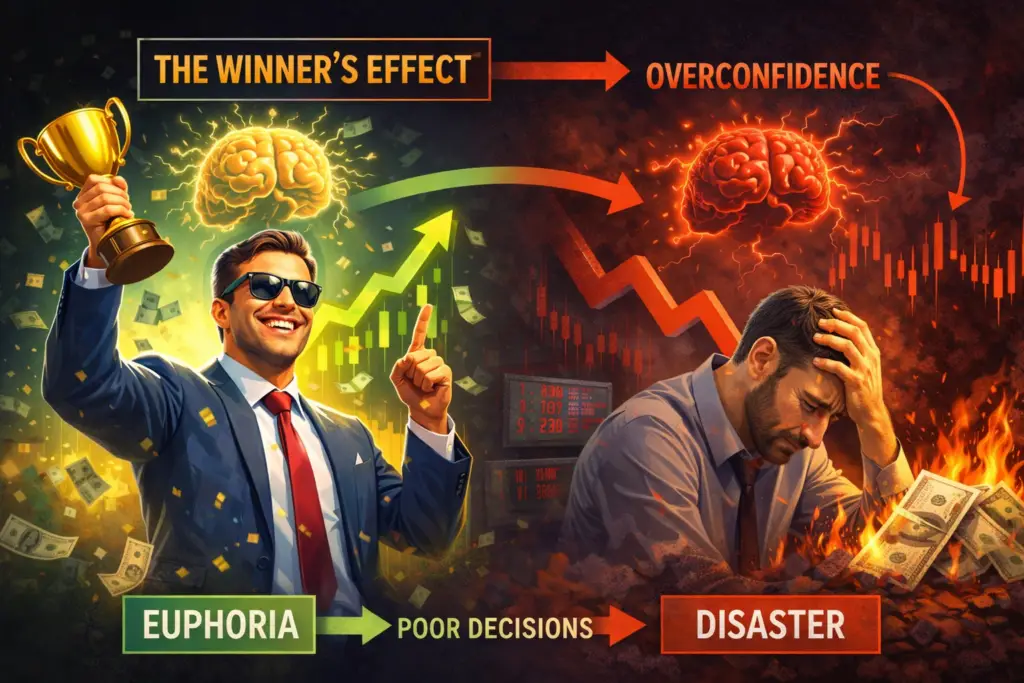
The Winner’s Effect describes a biological process where winning increases the likelihood of future victories by boosting confidence. In the popular The Winner’s Effect book by Ian Robertson, the author explores how power and success physically change the brain. However, in the world of high-stakes trading, this biological advantage quickly turns into a liability. When you win, your body releases a cocktail of testosterone and dopamine.
In his seminal work, The Winner’s Effect: How Power Affects Your Brain, neuroscientist Ian Robertson explains how winning literally reshapes the chemical pathways of the mind.
These chemicals change your brain’s architecture. Testosterone increases your appetite for risk. Dopamine reinforces the behavior that led to the win. Together, they create a feedback loop. This loop makes you feel smarter than the market. Traders often forget that the market does not care about their past successes.
Early in my trading journey, I had a week where every trade hit its target perfectly. I felt like I had finally “solved” the market. Because of this high, I doubled my risk on the next trade without a second thought. I wasn’t following a plan anymore; I was chasing the dopamine rush of being right. That single “confident” trade wiped out all my gains from the entire week.
The Neurobiology of a Blown Account
The transition from a “winning streak” to a “blown account” happens in the synapses of your brain. When The Winner’s Effect takes hold, the prefrontal cortex—the part of your brain responsible for logical decision-making—begins to take a backseat.
- The Testosterone Spike: Success increases testosterone levels. This hormone makes you more aggressive. You might start doubling your position sizes or ignoring your stop-loss levels.
- The Dopamine Flood: Dopamine is the “reward” chemical. It makes you crave the next win. When you are under the influence of high dopamine, you become “reward-sensitive” and “risk-blind.”
- Reduced Amygdala Activity: Usually, the amygdala triggers fear when you take a big risk. Under The Winner’s Effect, this fear response is dampened. You no longer feel the “sting” of potential loss until it is too late.
To understand the biological shift, one must look at how success physically changes the brain, where increased status leads to heightened neural sensitivity to rewards
How Reckless Overconfidence Leads to Ruin
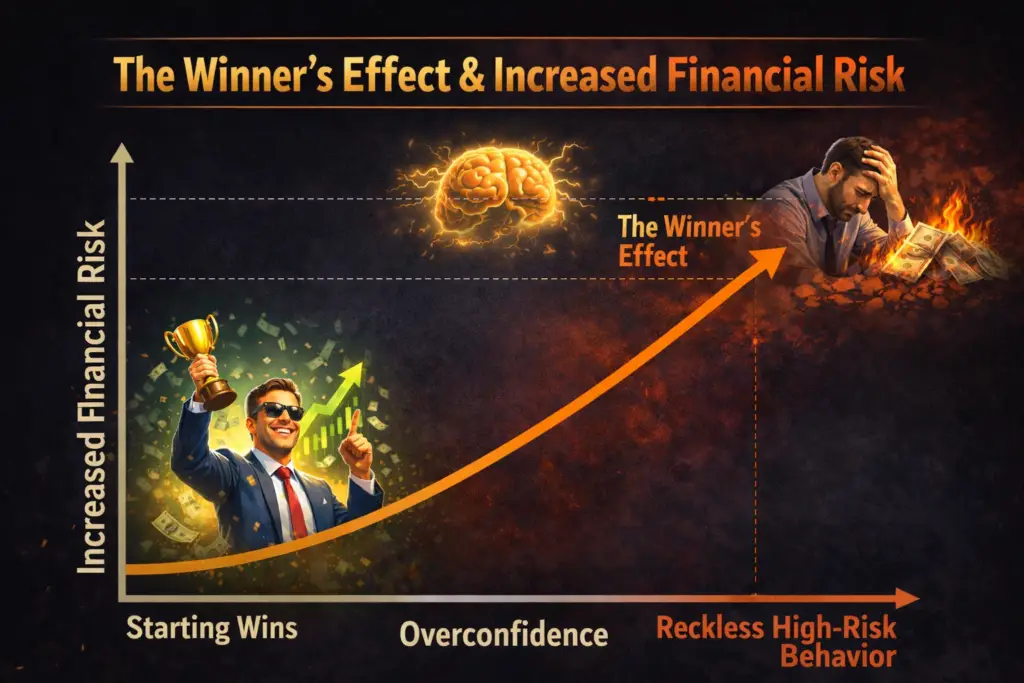
Overconfidence is the silent killer of trading accounts. Most traders do not lose their money because they lack a good strategy. They lose because they stop following their strategy during a hot streak. The Winner’s Effect convinces you that you have “cracked the code.”
You might find yourself entering trades that don’t meet your criteria. You believe your “intuition” is now superior to your data. This is a cognitive trap. Every trade is an independent event with its own probability. The market has no memory of your last five wins, but your brain is obsessed with them. Many people search for a The Winner’s Effect PDF to understand these traps, but applying the knowledge in real-time is the real challenge.
I once mentored a fellow trader who had a flawless strategy. He followed his rules for months and grew his account steadily. However, after a rare ten-trade winning streak, he succumbed to The Winner’s Effect. He stopped checking his indicators because he felt like a “genius” who could predict the next candle just by looking at the chart. Consequently, he ignored his stop-loss on a major trade, convinced the market would “have to” turn back in his favor. That single moment of reckless overconfidence didn’t just ruin his trade; it blew his entire account in under an hour. It was a painful reminder that the market humbles anyone who thinks they are bigger than the data
Identifying the Warning Signs
To protect your capital, you must recognize when The Winner’s Effect is clouding your judgment. Ask yourself these questions after a winning day:
- Am I trading larger sizes than my plan allows?
- Do I feel an intense “rush” or “high” when I think about the next trade?
- Am I skipping my pre-trade routine because I feel I don’t need it?
If you answered yes to any of these, you are likely operating under neurochemical bias rather than logic.
Strategies to Combat The Winner’s Effect
You cannot change your biology, but you can manage your environment. Professional traders use systems to guard against their own brains.
1. Mandatory “Cooling Off” Periods
After three consecutive wins, take a break. Walk away from the screen for at least two hours. This allows your dopamine levels to return to a baseline. Physical movement helps reset your nervous system and mitigates the immediate impact of The Winner’s Effect.
2. Strict Rule Automation
Use hard stops and automated position sizing. If your software manages the risk, The Winner’s Effect has less room to sabotage you. Don’t rely on your “willpower” when your brain is flooded with testosterone.
3. The “Next Trade” Mindset
Treat every trade as a completely new event. Remind yourself that the previous win provides zero statistical edge for the current setup. Consistency comes from discipline, not from “vibes.”
To stay objective, I now treat every win like a dangerous warning sign rather than a celebration. I have learned that my brain is my most unreliable partner when it is “happy.” Consequently, I force myself to close my laptop after a winning streak. This simple habit protects my capital from the biological urge to over-trade.
Why Psychological Capital is Vital
Your “Psychological Capital” is your ability to remain objective. The Winner’s Effect drains this capital. When you are overconfident, you are psychologically bankrupt. You become vulnerable to revenge trading once the inevitable loss finally occurs.
Protecting your mind is just as important as protecting your balance. A disciplined trader with a mediocre strategy will always outperform an overconfident trader with a “perfect” strategy. Master your biology, and you will master the markets.
Medical Disclaimer
The information provided in this article is for educational and informational purposes only and does not constitute medical advice, diagnosis, or treatment. Always seek the advice of your physician or other qualified health provider with any questions you may have regarding a medical condition or neurochemical imbalances. Never disregard professional medical advice or delay in seeking it because of something you have read on this website.
Author: Dr. Nirosh