The Introduction
It starts with a setup. You see the pattern, you enter the trade, and… green. The market moves in your favor. You take profit. You feel like a genius. Your heart rate is up, your palms are slightly sweaty, and you feel invincible .
So, what do you do next? You enter another trade immediately. And another.
Fast forward two hours: You have given back all your profits, plus 10% of your capital. You are exhausted, angry, and asking yourself, “Why couldn’t I just walk away?”
Hi, I’m Dr. Nirosh. As a medical doctor and a trader, I can tell you that this isn’t just a lack of “discipline.” It’s biology. Specifically, it’s a Dopamine Loop. And if you don’t treat the physiology, no amount of technical analysis will save your account.
The Diagnosis: What is the “Dopamine Loop” ?
In medicine, we study neurotransmitters. Dopamine is often called the “pleasure molecule,” but that’s a misconception. Dopamine is actually the molecule of craving and pursuit.
When you click “Buy,” your brain anticipates a reward. This anticipation spikes your dopamine levels higher than the reward itself.
Trading is addictive because it works exactly like a slot machine.
* If you won every time, you’d get bored.
* If you lost every time, you’d quit.
* But because you win sometimes and randomly, your brain goes into hyper-drive. This is called a Variable Ratio Reinforcement Schedule. It is the most addictive pattern known to behavioral psychology.This is the main problem in modern traders.
The Symptoms: Are You Trading or Gambling?
What we go peak we often having,
1. High Response Rate
As soon as they close a winning trade, they immediately look for the next entry. They cannot sit on their hands. The subject enters a flow state where time becomes irrelevant. They may skip meals or bathroom breaks because the brain believes the ‘big win’ is always one click away. I had same experience when i starting my trading journey.
2.Resistance to Extinction
They lose 5 trades in a row but keep trading the exact same setup, convinced the “law of averages” is about to pay out.
3.The “Near-Miss” Agitation
The traders think” i didn’t lose because I was wrong; I lost because I was stopped out by 1 pip!”This “almost win” encourages them to double their risk on the next trade, thinking they have “figured it out.”
4. The “Hunt” Anxiety (Anticipatory Dopamine)
They feel more alive/excited while the trade is open (floating P/L swinging up and down) than they do after they bank the profit.They might self-sabotage (hold a trade too long) just to keep the “rush” of the uncertainty going.
If you were paid a fixed salary (Fixed Interval), you would relax after payday. But because the Market ( pays you randomly, your brain stays in a permanent state of ‘Hyper-Vigilance.’ You aren’t greedy; you are chemically wired to hunt.
* The”Revenge” Pulse: When you lose, does your heart rate spike? Do you feel a physical need to “fix” it immediately? That is a fight-or-flight response (Cortisol), not a trading strategy.
* The “God Mode” Delusion: After a win streak, do you increase your lot size? That is dopamine inhibiting your frontal cortex (the logic part of your brain).
* Chart Hypnosis: Staring at the screen for 3 hours without taking a trade, just “waiting” for the rush.
4. The Prescription: How to Break the Loop and Stop Over-Trading.
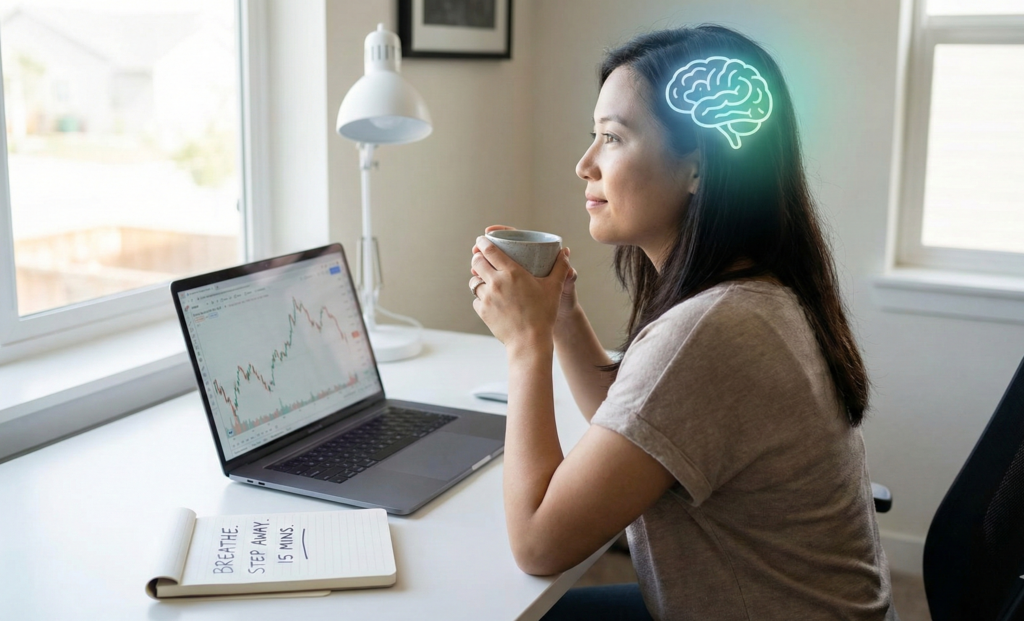
Here the gift by me. My advice as a doctor, you should have a action plan instead of “Stop trading”.
If a patient came to me with these symptoms, I wouldn’t just say “stop stressing.” I would prescribe a protocol. Here is your trading prescription:
1. The 15-Minute “Post-Trade” Washout
Dopamine has a half-life. After closing a trade (Win OR Loss), you are chemically compromised. You are strictly forbidden from clicking a button for 15 minutes. Walk away. Let your neurochemistry return to baseline.
2. Physical State Change (The Cortisol Flush)
If you take a bad loss, your body is flooded with Cortisol (stress hormone). Sitting in your chair makes it worse. You must physically move. Do 20 pushups or splash cold water on your face. This triggers the “Mammalian Dive Reflex” and slows your heart rate.
3. Switch to “Boring” Charts
If you are addicted to the 1-minute timeframe, you are addicted to the noise. Move to the 4H or Daily chart. Lower frequency = Lower dopamine spikes = Better decisions.
Conclusion
Trading is the hardest game in the world because you are fighting your own biology. Your brain is wired to hunt and gather, not to sit still and wait for a setup.
Medical & Financial Disclaimer: The content provided on https://www.google.com/search?q=TheDopamineDoc.com, including all text, graphics, and images, is for informational and educational purposes only. Although the author is a medical doctor, this content does not constitute a doctor-patient relationship, nor does it constitute medical advice, diagnosis, or treatment. Never disregard professional medical advice or delay in seeking it because of something you have read on this website.
Additionally, this content is not financial advice. Trading involves significant risk. You are solely responsible for your own investment decisions.
Perfect advice .
Beneficial for all not just traders
Thank you so much doctor.