Do your candlestick charts start blurring together after hours of scalping the markets? CVS in trading—scientifically known as Computer Vision Syndrome—is a silent profit killer that affects millions of crypto and forex traders worldwide. When you stare at screens for prolonged periods, your blink rate drops significantly, causing severe eye strain. Consequently, this physical fatigue leads to mental errors, missed entries, and emotional exits.
Identifying CVS in trading early gives you a massive competitive edge. Furthermore, understanding how your eyes function under the stress of volatile markets allows you to maintain peak performance. This guide explores why your vision blurs and how medical interventions can protect your career.
My Big Mistake,
As I am a doctor, but I made a big mistake. Even though I know about health, I ignored my body. One day, I came home very tired after working whole day at the hospital. However, I really wanted to trade Gold. My eyes hurt, yet I kept looking at the screen. Suddenly, the chart looked blurry. I thought the price was going up, so I clicked “Buy.” Unfortunately, I was wrong. The price was actually going down. As a result, I lost a week’s profit in one second because I could not see clearly. This was CVS in trading in action. I learned that tired eyes lose money.
Understanding CVS in Trading
Computer Vision Syndrome describes a group of eye and vision-related problems resulting from prolonged computer use. For traders, the intensity is higher because market movements require unblinking focus. Therefore, CVS in trading manifests differently than in typical office jobs.
The Mechanism of Blurry Charts
Your eyes must constantly focus and refocus as you switch between timeframes and monitors. Specifically, the ciliary muscles in your eyes lock into a spasm when you stare at a fixed distance for too long. This creates a temporary inability to focus, known as accommodation spasm.
Why Digital Pixels Matter
Moreover, digital screens emit pixelated light rather than solid images. Your eyes constantly struggle to maintain focus on these pixels, leading to visual noise. Thus, after four or five hours of watching price action, the candles might appear double or fuzzy. The American Optometric Association notes that uncorrected vision problems can further increase the severity of these symptoms.
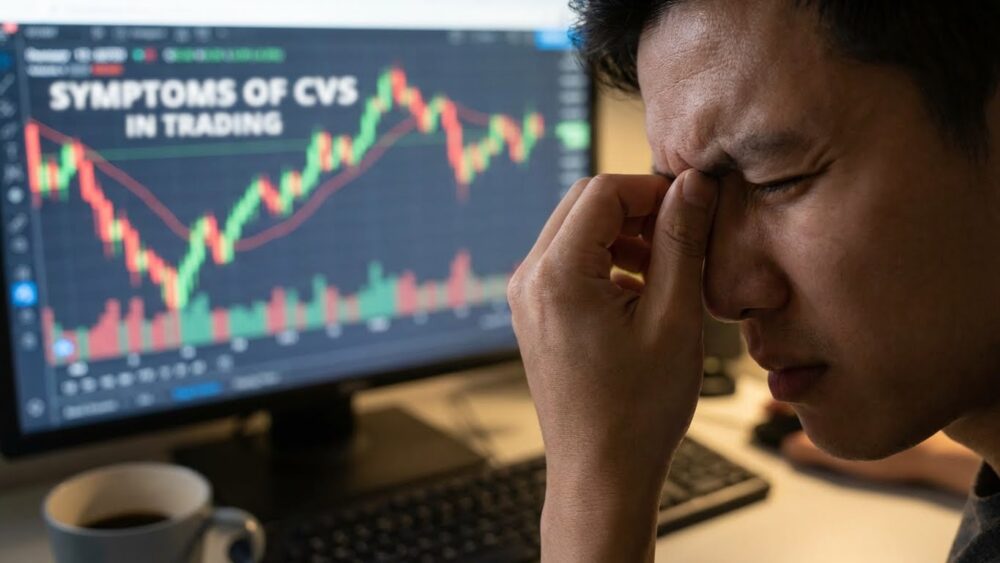
Key Symptoms to Watch
You must recognize the signs before they destroy your trading account.
- Eyestrain: Sore or tired eyes even after sleep.
- Headaches: Specifically around the forehead or temples.
- Dry Eyes: A gritty sensation, often due to reduced blinking.
- Neck Pain: Resulting from leaning forward to see small numbers.
Medical Rules for Blue Light Glasses
One of my best friend trades crypto full-time. He uses four monitors and sits there for 16 hours a day. However, he ignored his eye pain for a long time. Last year, he called me in panic. He said, “I see two screens!” He had double vision. It was not a stroke; on the contrary, it was severe eye strain from CVS in trading. Consequently, he had to stop trading for two weeks to rest his eyes. Because of this, he missed a big Bitcoin profit. He could not even look at his computer.
Many marketers hype blue light glasses, but do they actually help CVS in trading? The medical reality is nuanced. Blue light from screens scatters more easily than other visible light, reducing contrast and forcing your eyes to work harder.
Rule 1: Check the Light Spectrum
Not all glasses are equal. Effective glasses for CVS in trading should block blue-violet light (400-455nm). However, they must let beneficial blue-turquoise light pass through. If you block too much blue light during the day, you might damage your circadian rhythm.
Rule 2: Optimal Timing for Use
Research suggests that blue light blockers are most effective during evening trading sessions. For instance, if you trade the New York close or the Asian open (nighttime for many), these glasses prevent blue light from suppressing melatonin. Consequently, you sleep better after your session ends.
Rule 3: Prescription is Crucial
If you have a refractive error, plain blue light glasses won’t fix CVS in trading. You must correct your astigmatism or nearsightedness first. Otherwise, the blue light filter is just a bandage on a broken leg.
What Glasses Worked for Me
At first, I bought cheap $10 glasses. They did not work. They just made the screen look yellow. Furthermore, I still had headaches. Then, I bought good prescription glasses with a medical blue coating. This worked very well. Now, I can trade the New York session without pain. It feels like the “sand” is gone from my eyes.
Evidence-Based Strategies to Combat CVS
Beyond glasses, you need a system. Experts recommend specific protocols to reduce digital eye strain effectively.
The 20-20-20 Rule
This is the gold standard. Every 20 minutes, look at something 20 feet away for at least 20 seconds. This simple act breaks the accommodation spasm in your ciliary muscles. For a trader, this means looking away from the screen after every candle close on a 15-minute chart. Mayo Clinic specialists emphasize that frequent breaks are more effective than eyewear alone.
Blink Training for Traders
Studies show that when you stare at a screen, your blink rate drops by nearly 66%, leading to dry and irritated eyes. According to the American Academy of Ophthalmology, conscious blinking is essential to keep the cornea lubricated. Therefore, you must force yourself to blink fully. Some professional traders even use “blink” stickers on their monitors as reminders.
Monitor Ergonomics
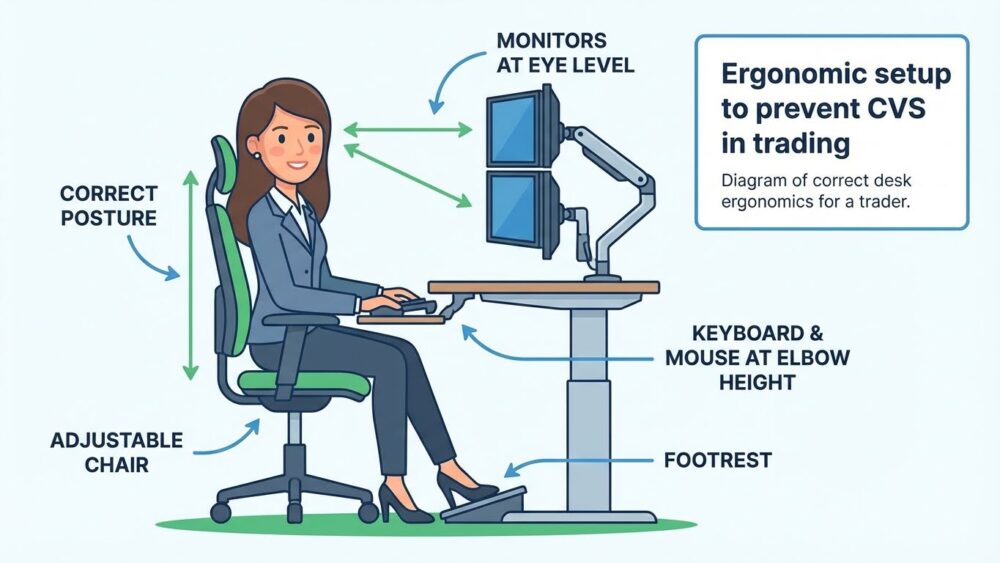
Position your trading setup correctly. Your screen should be 20 to 28 inches from your eyes and 4 to 5 inches below eye level. This downward gaze covers more of your eyeball with your eyelid. As a result, this reduces evaporation and prevents CVS in trading symptoms.
Optimizing Your Trading Environment
Lighting plays a crucial role. Most traders love “dark mode” charts, but if your room is pitch black, the contrast ratio is too high. This forces your pupils to dilate and constrict rapidly as you look away from the screen.
Bias Lighting Techniques
Place a soft LED strip behind your monitor. This reduces the contrast between the bright screen and the dark wall.
Managing Glare
Never place your monitor directly in front of a window. The glare will instantly trigger CVS in trading. Additionally, consider using a matte screen filter if your room is very bright.
Conclusion
Ignoring CVS in trading is a risk management failure. Just as you protect your capital with stop-losses, you must protect your vision with proper habits. By implementing the 20-20-20 rule, optimizing your lighting, and using medically appropriate eyewear, you ensure that your eyes remain sharp for every breakout.
Remember, the market will always be there, but your eyesight is a depreciating asset if you don’t care for it. Start treating your vision as part of your trading hardware today.
Final Thought
I changed my habits, and now I trade better. I do not trade when my eyes hurt. I treat my body like an athlete. Consequently, this has helped my profit. Do not wait until you see double like my friend. Protect your eyes today.
Medical Disclaimer
This article provides general information about CVS in trading and eye health. It is not intended as medical advice, diagnosis, or treatment. The information presented should not replace consultation with qualified healthcare professionals. If you experience persistent eye pain, vision changes, or severe headaches, consult an ophthalmologist immediately.
Author: Dr. Nirosh