
As a medical doctor and an active trader, I often see how the biological “wiring” of the human brain directly conflicts with the demands of the modern stock market. You might think your biggest problem is a bad strategy or a lack of discipline. However, the real reason why you revenge trade is rooted deep within your neurobiology.
In this article, we will explore the internal “traffic jam” in your brain that leads to impulsive decisions. I have faced these same mental hurdles on my own trading journey. I spent countless hours analyzing how a single red trade can turn into a day-long disaster. By understanding the “why,” you can finally implement the “how” to stop the cycle once and for all.
Why You Revenge Trade: A Doctor’s Guide to the Trading Brain
When you experience a sudden financial loss, your brain does not see it as a mere digital deduction. Instead, it perceives a direct threat to your survival. This is exactly why you revenge trade. Your nervous system enters a state of high alert, and your rational thinking goes out the window.
Imagine your brain’s neurotransmitters as fuel for a high-performance car. When you are winning, you have plenty of “focus fuel” (dopamine). But when you hit a loss, the fuel tank leaks, and your brain starts screaming for a refill. That “refill” is the impulsive trade you take to “get even”.
“I remember one Tuesday morning when I lost LKR 20,000 in five minutes. My heart was racing, and I felt like I had to win it back immediately or my day was ruined.”
The Neuroscience of the Amygdala Hijack
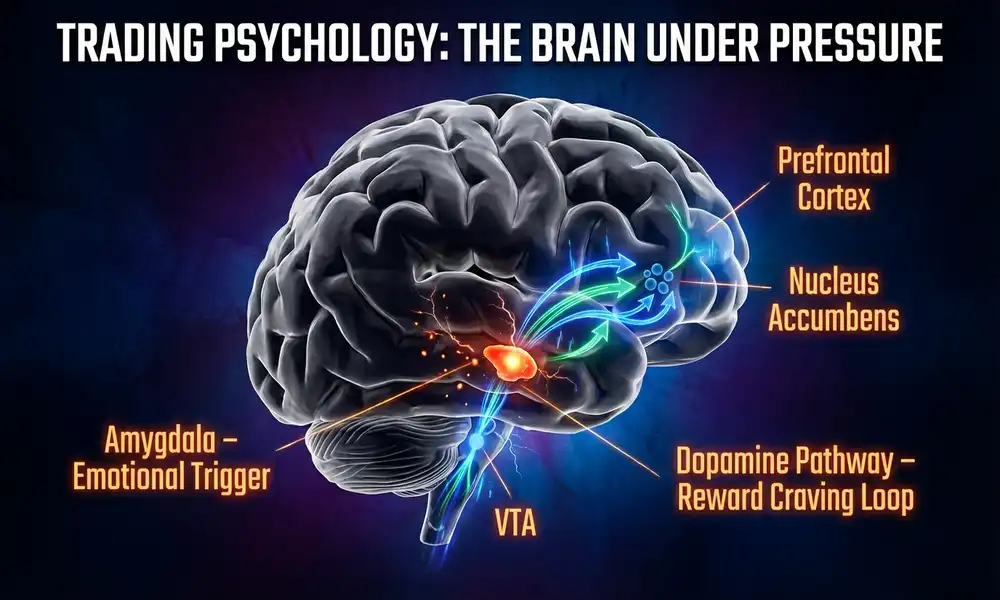
To understand why you revenge trade, we must look at the specific structures within the brain. Specifically, we focus on the ventral tegmental area (VTA) and the nucleus accumbens. These areas form the heart of your reward system.
When you lose money, your brain experiences an “Amygdala Hijack”. The amygdala is the emotional center of the brain. It is responsible for the “fight or flight” response. In a trading context, “fight” manifests as revenge trading. The amygdala sends an emergency signal that bypasses the prefrontal cortex—the part of your brain responsible for logic and risk management.
Essentially, your brain’s “security alarm” is so loud that you can’t hear your “analytical computer”. This dysregulation of dopamine levels creates a frantic need to erase the pain of the loss. If you don’t understand this mechanism, you will remain a slave to your biology.
Practical Protocols
How to Kill the Urge Today Knowing why you revenge trade is the first step, but you need a tactical plan to stop it. Here are five “Doctor’s Orders” to reset your baseline and protect your capital.
- The 15-Minute Physical Circuit Breaker
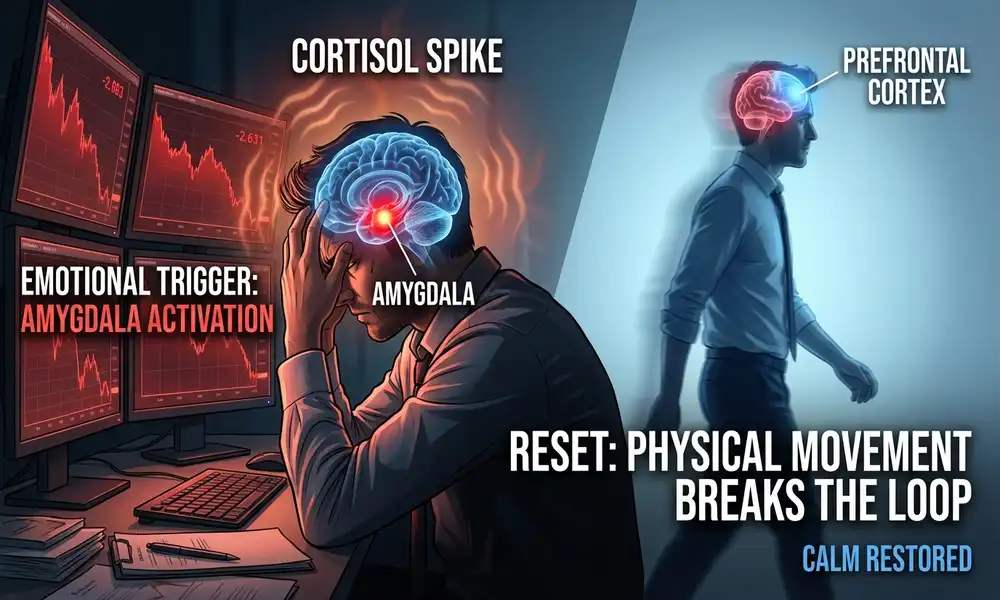
The moment you feel the heat of a loss, you must move your body. Physical movement helps clear cortisol, the stress hormone
Action: Walk away from your desk.
Why: It breaks the visual “loop” that keeps your brain locked in a state of panic.
- Neuro-Respiratory Reset
You can use your breath to talk directly to your nervous system
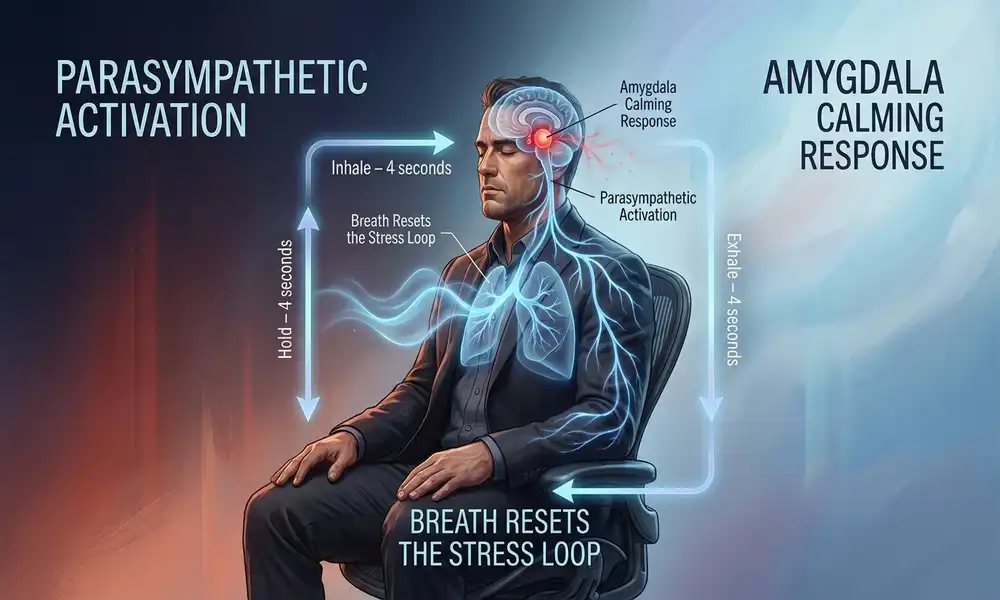
Action: Practice “Box Breathing”—inhale for 4 seconds, hold for 4, exhale for 4, hold for 4.
Why: This activates the parasympathetic nervous system, telling your amygdala that the “emergency” is over.
- The “Dopamine Diversion”
Since your brain is starving for a win, give it a small, non-financial victory.
Action: Complete a simple task, like washing a dish or doing ten pushups.
Why: This provides a tiny, safe “dopamine hit” that satisfies the brain’s craving without risking your account.
- Loss-Limit Automation
Don’t trust your future self during a crisis.
Action: Set a hard “daily loss limit” on your trading platform.
Why: This acts as a physical barrier when your mental barriers fail.
- Transition to “Journaling the Emotion”
Writing down your feelings engages the logical side of your brain.
Action: Write, “I feel angry because I lost X amount, and my brain wants to gamble to fix it”.
Why: Labeling the emotion reduces its power over you.
Emotional vs. Systematic Trading: The Comparison
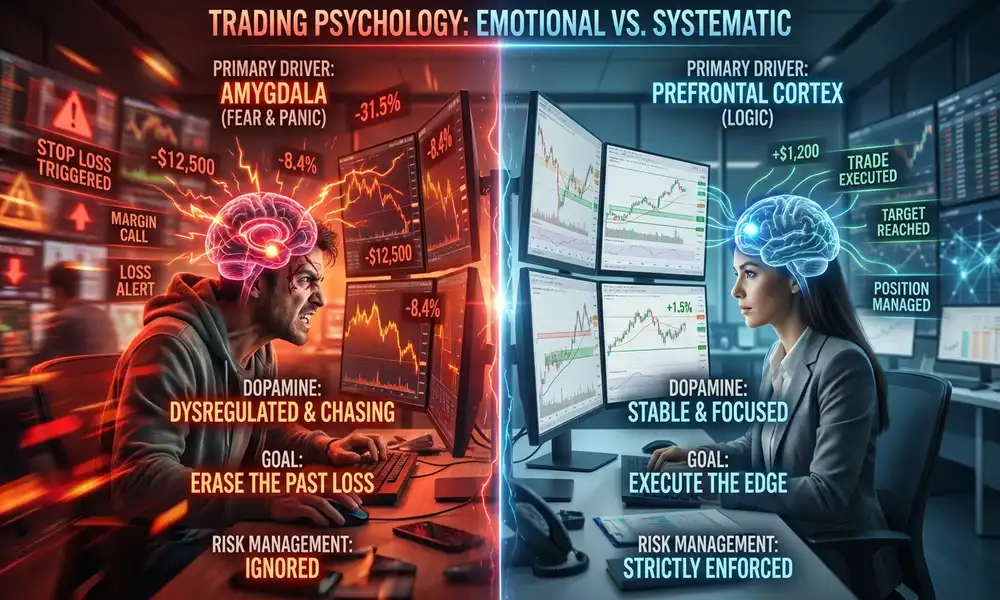
Visualizing the difference can help you identify which state you are in. Using a comparison table is a great way to audit your performance.
| Feature | Revenge (Emotional) Trading | Systematic (Pro) Trading |
| Primary Driver | Amygdala (Fear/Panic) | Prefrontal Cortex (Logic) |
| Dopamine Level | Dysregulated & Chasing | Stable & Focused |
| Goal | Erasing the past loss | Executing the current edge |
| Risk Management | Ignored or abandoned | Strictly enforced |
My Own Experience: The “Red Mist”
I have personally felt the “red mist” of a losing streak many times. One morning, I lost a significant amount of money on a single trade. I felt my heart pounding and my face getting hot. Instead of stopping, I doubled my position size to win it back.
I was not thinking about my strategy anymore. I was only thinking about the pain in my chest. By the end of the day, I had lost three times more than my daily limit. It took me days to recover mentally. Now, I use the physical circuit breakers I mentioned above to protect my account and my peace of mind.
Conclusion: The Doctor’s Orders
To reach your goals and stop the cycle of losses, you must treat your trading desk like a clinical environment. You cannot win if your brain is in a state of emergency.
- Accept the Biology: Stop blaming your “weakness” and start managing your amygdala.
- Follow the Protocol: Use the 15-minute break every single time you hit a stop-loss.
- Watch Your Inputs: High stress and poor physical health make revenge trading much more likely.
- Think Long-Term: One trade does not define your career, but one emotional outburst can end it.
The Doctor’s Orders: Key Takeaways
- Acknowledge the Biology: Understand that the urge to revenge trade is a physical response, not a character flaw.
- Interlink Your Habits: High caffeine intake can make the “half-life” of your patience shorter—check out my article on Caffeine Half-Life to see how it affects your focus.
- Protect Your Body: Physical pain, like Gamer’s Thumb, can increase your stress levels and make you more prone to impulsive trading.
- Build a System: Use the Practical Protocols daily, even when you aren’t losing, to build “mental muscle”.
External Resources for Further Reading
National Institutes of Health (NIH) – The Reward Circuitry: This peer-reviewed study explains the deep mechanics of how dopamine affects our decision-making and risk-taking.
PubMed – Stress and Decision Making: A clinical look at how cortisol and stress “hijack” the logical brain during high-stakes scenarios like trading.
Psychology Today – The Psychology of Losses: An excellent resource for understanding why the human mind feels the pain of a loss twice as much as the joy of a gain.
Medical Disclaimer
This article is for educational and informational purposes only. It is not a substitute for professional medical advice, diagnosis, or treatment. Always seek the advice of your physician or other qualified health provider with any questions you may have regarding a medical condition or mental health concerns. Trading involves significant risk and is not suitable for everyone.
Have you ever felt that “red mist” after a loss where you just couldn’t stop clicking the buy button? Let me know your experience in the comments below!
About the Author
Dr. Gihan Nirosh Hasintha, MBBS (Sri Lanka), is a medical professional with a focus on sports medicine and performance neuroscience.
Dr. Nirosh is a medical doctor and active trader who specializes in the physical and mental health challenges faced by traders, gamers, and desk professionals. He combines clinical medical knowledge with real-world trading experience to create practical, evidence-based solutions that improve performance and reduce pain.
👉 Read Dr. Nirosh’s full bio
Author-Dr. Nirosh