
As a performance neuroscience specialist, I frequently help clients who battle severe gaming addiction. Have you ever sat down at your computer to play? You promise yourself you will only play for thirty minutes. Suddenly, you look at the clock. Five hours have vanished entirely. Your eyes burn, and your posture suffers greatly. Yet, your brain violently craves just one more match. You are definitely not alone. Millions of people experience this exact phenomenon daily.
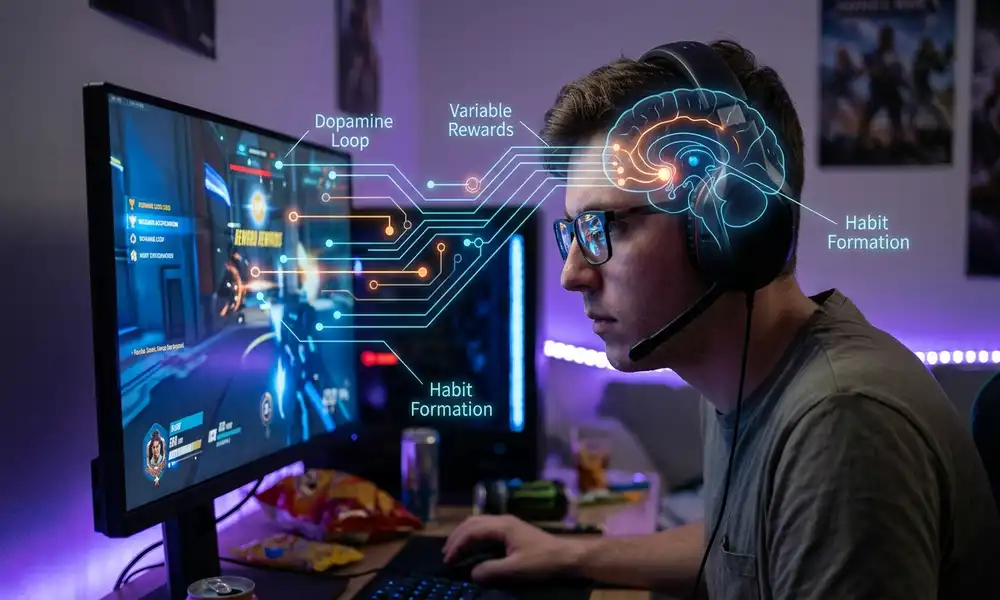
We often label this behavior a simple lack of willpower. People blame laziness for their failures. We tell ourselves we just need to try harder tomorrow. However, the reality of gaming addiction remains far more complex and highly mechanical. When you sit down to play a modern video game, you do not just interact with pixels. You actively engage with a system carefully crafted by behavioral psychologists. Developers design these systems to hijack your deepest survival mechanisms.
My friends and I used to play story games like Call of Duty all night long. We always said “just one more game” to each other. But we never actually stopped. The next day, I could not focus on my studies at all. My friend even missed his morning classes because he played too much. We felt tired, lazy, and totally drained. I realized then that the game was controlling us. We needed a plan to get our focus back.
What if you could understand the exact biological levers pulling inside your head? Furthermore, what if you could take the very mechanisms that fuel gaming addiction and redirect them? You can build unbreakable focus in your real life. The secret to achieving this does not require magic. It requires understanding a hidden loop running in your nervous system right now.
To break free from gaming addiction, we must first uncover a shocking truth. We need to examine a chemical you have likely heard of, but almost certainly misunderstand.
The Neuroscience of Gaming Addiction: The Dopamine Mirage
If you ask the average person what dopamine is, they usually call it the “pleasure chemical.” They believe your brain releases dopamine to make you feel good after you eat a delicious meal or win a match.
This assumption is fundamentally incorrect.
Dopamine actually functions as the chemical of anticipation and motivation. It serves as the neurological equivalent of a hunting dog picking up a fresh scent. When your brain releases dopamine, it does not say, “This feels great.” Instead, it screams, “A reward is nearby, so do whatever it takes to get it!”
To explain this clearly, think of your brain’s communication network like a massive, bustling city. Your neurotransmitters act as the high-octane fuel keeping the cars moving swiftly. Meanwhile, the synaptic gaps represent the complex intersections where signals must cross safely. When you anticipate a reward, you flood these intersections with fuel.
In the 1990s, neuroscientist Robert Sapolsky conducted a famous experiment with monkeys. He trained the animals to press a lever whenever a light came on. Consequently, the lever would deliver a sugary treat. Sapolsky measured the electrical activity in their brains. He discovered something truly incredible. The massive spike in dopamine did not happen when the monkey actually ate the treat. Instead, the spike happened the exact moment the light turned on. The dopamine rewarded the pursuit, not the final prize.
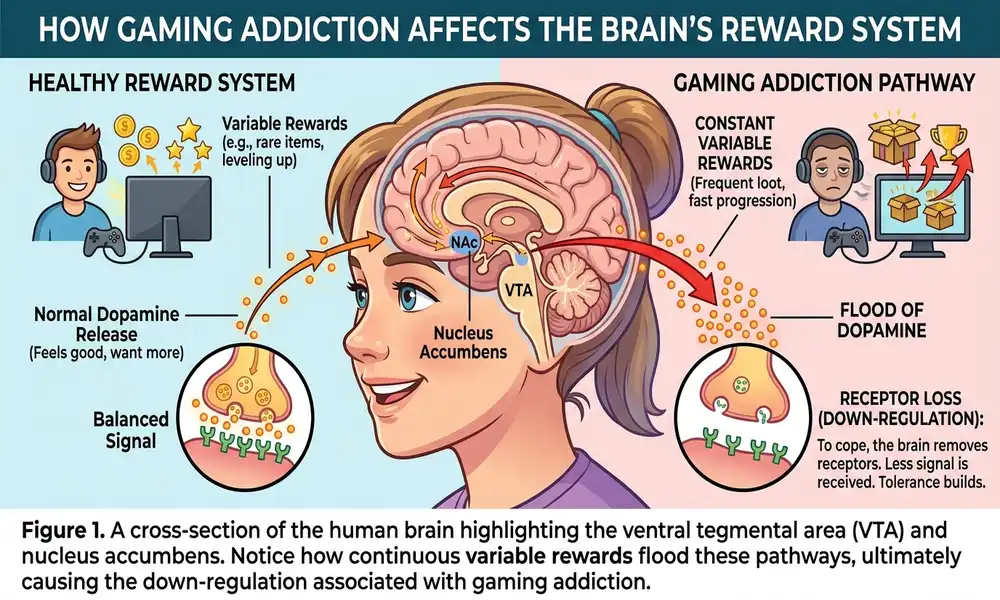
Video games act as the ultimate light-switch for your brain. Before a match even starts, your brain prepares for action. As you sit in the loading screen, your ventral tegmental area (VTA) pumps dopamine directly into your nucleus accumbens. Your brain intensely anticipates the win, the loot drop, or the rank up. This intense anticipation creates sudden hyper-focus. You become completely locked in.
To understand this chemical process fully, you can review this peer-reviewed study from PubMed on dopamine release during video game play. This specific research clearly illustrates how digital rewards permanently alter our brain chemistry and drive compulsive behavior.
Understanding Gaming Addiction: The Compulsion Loop
To understand why you cannot stop playing, you need to understand the “Skinner Box.” B.F. Skinner was a brilliant psychologist who studied animal behavior. He placed rats in specially designed boxes equipped with mechanical levers. Initially, he found that if a rat pressed a lever and received a food pellet every single time, the rat behaved normally. It only pressed the lever when hungry. The routine became predictable and boring.
However, Skinner then changed the core rules of the experiment. He rewired the box so the lever only delivered food sometimes. One press might yield absolutely nothing. The next press might also yield nothing. But the third press might randomly deliver three large pellets.
The rats completely lost their minds. They became overwhelmingly obsessed. They pressed the lever frantically, entirely ignoring sleep and water. Because they never knew exactly when the reward would arrive, their dopamine levels remained constantly elevated. They existed in a state of perpetual anticipation. Scientists call this phenomenon a Variable Ratio Reinforcement Schedule.
Modern video games function as digital Skinner boxes. This perfectly explains the grip of gaming addiction.
Think about your own experiences. When you open a digital loot box, you do not know if you will get a rare item or worthless trash. When you queue for a competitive multiplayer match, you cannot predict if your team will dominate. Unpredictability forms the core of the experience.
Developers do not include this unpredictability by accident. It operates as a highly engineered compulsion loop. Your brain quickly becomes addicted to the sheer uncertainty. You no longer play for the actual reward. You play strictly for the dopamine spike that comes from pulling the digital slot machine lever.
To explore the psychological impact of these systems, read this comprehensive NIH article detailing the effects of variable ratio schedules on human behavior. The data proves that uncertain rewards create the strongest possible behavioral addictions.
How Gaming Addiction Causes Dopamine Depletion
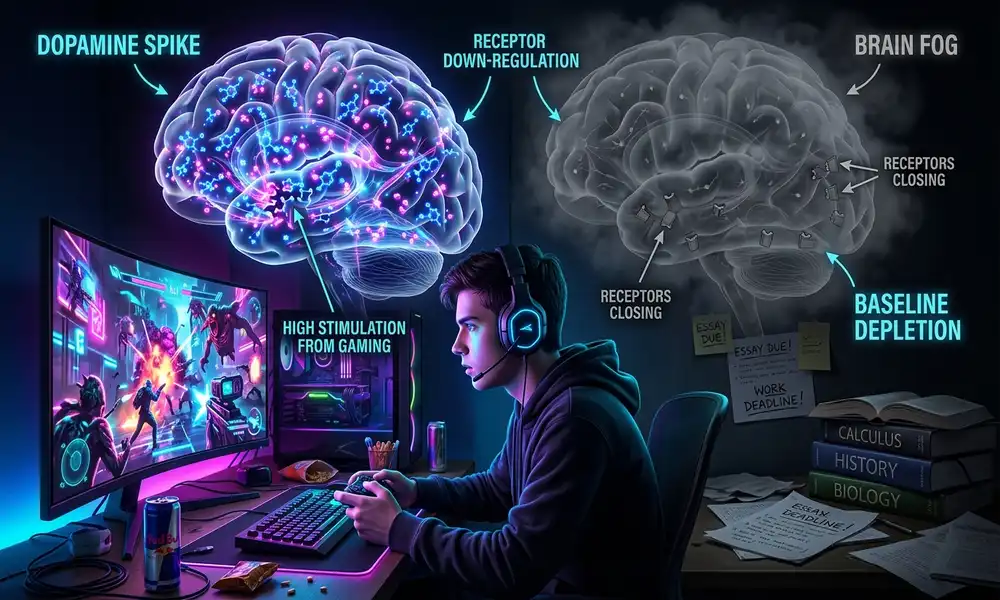
This intense, artificial stimulation carries a devastating biological cost. The cost bleeds out of the game and actively destroys your ability to function in the real world. We call this terrifying phenomenon “Baseline Depletion.” Consequently, this explains why reading a textbook suddenly feels physically painful.
Imagine your brain maintains a baseline level of dopamine. This baseline dictates your general mood. Furthermore, it regulates your daily motivation and your ability to focus on normal tasks.
When you play a highly stimulating video game for several hours, you force your brain to dump unnatural amounts of dopamine. You operate at an absolute, euphoric peak. However, your human body hates imbalance. It always strives for homeostasis, which means a state of internal equilibrium.
When your brain detects this massive chemical flood, it panics. To protect itself from severe overstimulation, it begins shutting down its own dopamine receptors. It effectively boards up the biological windows to block out the storm. Scientists call this defensive process down-regulation.
Eventually, you turn off the computer. The massive artificial dopamine spikes finally stop. But here lies the terrifying part: your receptors remain closed tight.
Now, you possess fewer active dopamine receptors than a normal, healthy person. Consequently, your baseline motivation crashes hard. You attempt to sit down and read a report. Normally, these quiet activities provide a small, steady trickle of dopamine. That trickle keeps a healthy brain engaged. But for your severely down-regulated brain, this tiny trickle cannot register.
You feel incredibly restless. You experience severe brain fog. An overwhelming sense of boredom washes over you, almost mimicking physical anxiety. You literally lack the neurochemical hardware required to focus on anything normal.
This mechanism serves as the exact foundation of gaming addiction. You do not return to the game because you want to have fun. You return because gaming represents the only activity stimulating enough to pierce through your damaged receptors. It makes you feel “normal” again.
I remember trying to study for my medical exams after a long weekend of gaming. I would stare at the page, but the words meant nothing. My brain felt like it was wrapped in thick cotton. I felt so anxious just sitting still. I only felt relief when I opened up YouTube or started another game. It was a vicious cycle.
Many people reach this terrible point and assume their attention span is permanently broken. They believe they have ruined their brains forever. But they miss a crucial piece of the biological puzzle. The brain acts like plastic, not rigid stone. If you understand the rules of neuroplasticity, you can reverse-engineer this entire crisis.
Reversing Gaming Addiction: Neuroplasticity and Flow State
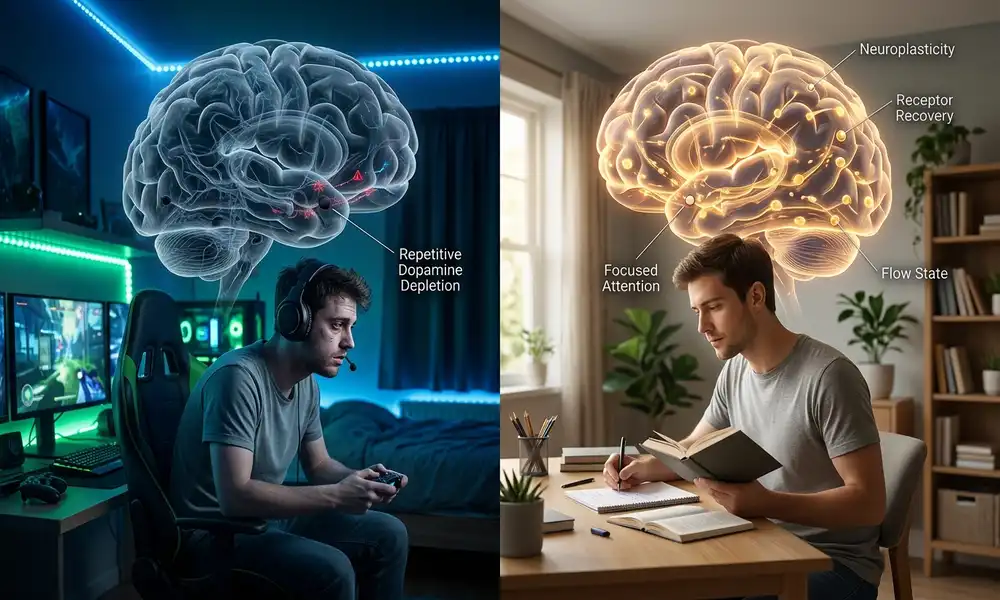
Neuroplasticity describes your brain’s amazing ability to reorganize itself. It forms new neural connections throughout your entire life. Just as your brain adapted to intense gaming by shutting down receptors, it can adapt again. It will open them back up if you lower your environmental stimulation.
For a deep dive into how your brain heals itself, I suggest reading this detailed PubMed publication explaining neuroplasticity and behavioral recovery. The research confirms that focused behavioral changes physically rewire the brain.
However, you cannot simply wish your focus back into existence. You must actively force the biological adaptation.
This reality birthed the concept of a “Dopamine Detox.” While internet influencers often exaggerate this idea, the underlying clinical principle remains entirely sound. If you remove highly stimulating activities from your daily environment, your brain experiences severe withdrawal initially. The boredom will feel intensely uncomfortable.
But if you hold the line courageously, the magic finally happens. After a short period of strict deprivation, your brain realizes the dopamine floods have vanished. Desperate for any stimulation at all, it slowly begins to up-regulate its closed receptors. It un-boards the windows.
Suddenly, the small trickle of dopamine you receive from reading a book engages your focus. Your natural attention span beautifully returns. The colors of the real world begin to sharpen once again.
Avoiding games entirely is not always realistic for everyone. The true objective involves transitioning from a state of compulsive gaming addiction into a state of intentional “Flow.”
Psychologist Mihaly Csikszentmihalyi coined the term “Flow.” He used it to describe a state of deep, effortless concentration. In a flow state, you easily lose track of time. Your ego dissolves completely. You perform at your absolute peak capability.
Gaming addiction and Flow look very similar from the outside. Both involve someone sitting at a desk, hyper-focused for many hours. But internally, they represent exact opposites.
The compulsion loop heavily drives addiction. External, unpredictable rewards pull you along forcefully. You feel anxious if you cannot play. You feel drained and deeply guilty when you finally stop. The algorithm controls you.
Internal mastery natively drives Flow. It occurs naturally when a challenge perfectly matches your current skill level. You focus entirely on the process, not the shiny reward. When you step out of a true flow state, you feel energized and clear-headed. You remain entirely in control.
The ultimate goal requires mastering your dopamine system. You must learn to enter a flow state in your work without falling back into the compulsion trap. To bridge this gap, you must implement a strategic, daily protocol.
Practical Protocols to Break Gaming Addiction
You now understand the true enemies: variable rewards, unnatural dopamine anticipation, and severe receptor down-regulation. Here is the exact framework to take your brain back today.
- Eradicate the Variable Reward – If you want to play video games safely, you must radically change what you play. Developers design competitive multiplayer games and live-service games to exploit the variable ratio schedule. They act as dangerous digital slot machines.
Instead, choose story-driven, single-player games. They offer a clear beginning, middle, and end. They do not rely on endless, unpredictable matchmaking algorithms. They provide steady, healthy narrative progression. By shifting your diet away from variable-reward models, you instantly defeat gaming addiction at its source.
- Insert Artificial Friction – Engineers design video games to have absolutely zero friction. You click a bright icon, and within seconds, you are immersed. To shatter the compulsion loop, you must introduce massive friction into the startup process.
Never rely on pure willpower. Willpower acts as a finite resource that drains quickly throughout the day. Instead, rely heavily on smart environmental design. Unplug your computer’s graphics card. Uninstall the video game after every single session. Put your gaming mouse in a completely different room. By making the startup process incredibly annoying, you successfully interrupt the automatic dopamine cycle.
- The 30-Minute Boredom Barrier – When you sit down to do difficult work, your damaged brain will scream at you. It will beg you to open a new tab or start a game. This physical discomfort feels completely normal. It represents the literal feeling of neuroplasticity attempting to occur.
You must commit to sitting with that specific boredom for exactly thirty minutes. Do not fight the feeling. Acknowledge it peacefully. Tell yourself, “I am feeling the lack of dopamine right now, and that is perfectly fine.” If you survive the first thirty minutes without seeking a cheap dopamine hit, your brain will surrender. It will naturally latch onto the work simply because it represents the only stimulation available.
If you struggle to apply these steps effectively, you might need to rebuild your foundational attention span first. Therefore, I highly recommend reading my detailed guide on Optimizing Your Daily Focus for Deep Work.
The Final Reality Check
Understand the Science: Gaming addiction results directly from dopamine receptor down-regulation, not a simple lack of willpower.
- Identify the Trap: Variable ratio reinforcement schedules keep you addicted to unpredictable digital rewards.
- Embrace Neuroplasticity: You can physically repair your focus by removing high-stimulation triggers.
- Apply Artificial Friction: Make bad habits incredibly difficult to start by changing your physical environment.
Understanding the mechanism of gaming addiction removes the heavy shame from the equation. You are certainly not lazy. You simply brought a biological human brain to a fight against supercomputers.
However, understanding this mechanism also completely removes your excuses. Now that you know exactly how the compulsion loop destroys your focus, the responsibility rests entirely on your shoulders. You hold the biological keys to your own attention span. You can continue to let algorithms dictate your neurochemistry. Or, you can embrace the friction and reclaim your raw, biological power.
Have you tried a dopamine detox to cure your gaming addiction? Let me know about your personal experiences in the comments below!
Author Bios:
Dr. Nirosh is a medical doctor and active trader who specializes in the physical and mental health challenges faced by traders, gamers, and desk professionals. He combines clinical medical knowledge with real-world trading experience to create practical, evidence-based solutions that improve performance and reduce pain. 👉 Read Dr. Nirosh’s full bio