
The SpaceX mindset does not come from loving rockets. It comes from a brain that runs on a different reward system than most brains run on. Elon Musk built SpaceX, Tesla, and PayPal because his dopamine circuits reward him for chasing goals that feel almost impossible. Every founder who builds a massive company shares this same SpaceX mindset, and every smart investor now studies this mindset before they commit capital to the next breakthrough company. This article breaks down that mindset, shows you how to train it, and explains exactly how millionaires position their money around the next generation of world-changing companies in 2026.
I write this article from the intersection of neuroscience and performance psychology, the same lens I use when I analyze trading cognition and biohacking strategies on this site. Company building and wealth building both run through the same brain circuits: dopamine, risk tolerance, and delayed gratification. Once you understand the SpaceX mindset, you understand why some founders reach Mars while others quit after their first rejected pitch deck.
Why The SpaceX Mindset Runs On Dopamine
Dopamine does not just reward pleasure. It rewards anticipation of a goal, especially a goal that feels almost impossible to reach. This is why founders like Musk, Jeff Bezos, and Sara Blakely describe their work as addictive rather than exhausting. Their brains release dopamine not when they finish a task, but when they chase a target that sits just beyond their current ability. This anticipation loop sits at the core of the SpaceX mindset.
[In my own consultations with entrepreneurs, I notice this pattern constantly — the founders who succeed treat every setback as a dopamine trigger rather than a failure signal.]
Neuroscientists at Stanford and MIT link this behavior to the mesolimbic pathway, the same brain circuit that drives gamblers, athletes, and traders. Musk himself has spoken publicly about setting audacious deadlines that he knows he will miss, because the pressure itself generates the drive he needs to move fast. You can read more about his approach to ambitious deadlines through SpaceX’s official mission page, where the company outlines its Mars colonization timeline.
The SpaceX mindset explains why massive companies rarely emerge from comfortable, risk-averse minds. They emerge from founders who treat uncertainty as fuel instead of fear.
The Four Traits Behind The SpaceX Mindset
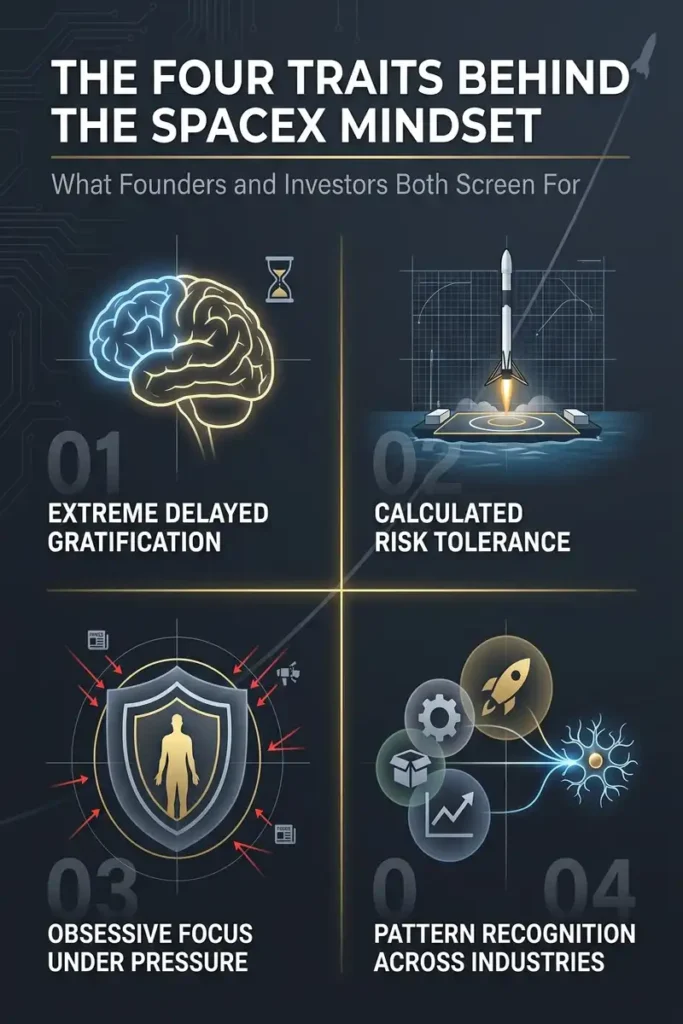
Every founder who builds a company at the scale of SpaceX shares four measurable cognitive traits. You can train these traits, and investors actively screen for them when they evaluate early-stage founders who show signs of the SpaceX mindset.
1. Extreme Delayed Gratification
Most people cannot tolerate waiting five years for a payoff. SpaceX operated for years without profitability, and Tesla nearly went bankrupt multiple times before it became profitable. Founders with this trait activate their prefrontal cortex to override the amygdala’s short-term panic response. They train this skill the same way traders train it: through repeated exposure to discomfort without escape.
2. Calculated Risk Tolerance
Reckless founders fail fast and quietly. Founders with a true SpaceX mindset take enormous risks, but they calculate every variable before they commit. Musk did not guess that reusable rockets would work; his engineering team modeled thousands of failure scenarios before the first successful landing in 2015. This calculated risk tolerance separates gamblers from visionaries.
3. Obsessive Focus Under Public Pressure
Building a massive company means absorbing criticism from media, competitors, and even your own investors. Founders who scale past the first ten years develop a psychological shield against public judgment. They redirect that pressure into focus rather than anxiety, a skill closely related to the cortisol-regulation techniques traders use during high-volatility markets.
4. Pattern Recognition Across Industries
Bezos built Amazon by recognizing patterns from retail logistics and applying them to internet infrastructure. Musk applied automotive manufacturing patterns to rocket production. This cross-industry pattern recognition activates the brain’s associative cortex, the same region that skilled traders use when they read market cycles.
Case Study: How The SpaceX Mindset Actually Scaled A Company
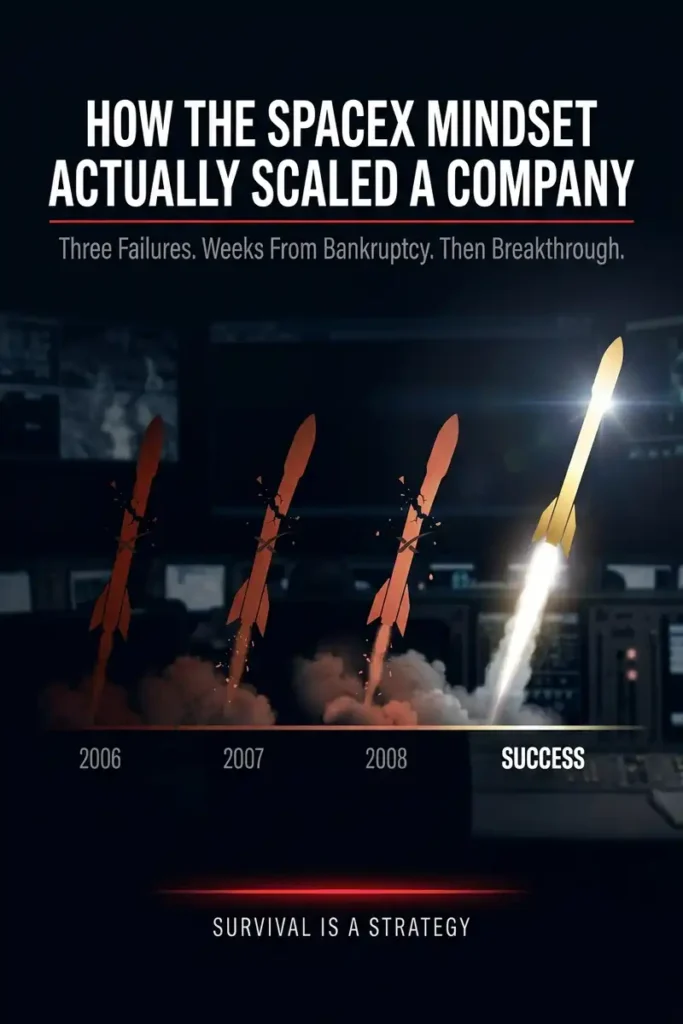
SpaceX did not become a $350 billion company overnight. The company survived three consecutive rocket failures between 2006 and 2008 before its fourth launch finally succeeded, just weeks before the company ran out of money. This near-collapse moment defines the psychological profile behind the SpaceX mindset: founders operate closest to failure right before their breakthrough.
Musk personally funded SpaceX with proceeds from his PayPal sale, then reinvested nearly everything back into the company during its most fragile years. This pattern repeats across nearly every massive company in history. Bezos funded Amazon’s early years with his own savings and family loans. Sara Blakely built Spanx using $5,000 of personal savings before she pitched it to Neiman Marcus in person.
You can review SpaceX’s full launch history and funding milestones through This independent overview of the company’s development, which documents the exact timeline investors now study when they evaluate aerospace startups.
The Investor’s Perspective: How Millionaires Apply The SpaceX Mindset To Their Portfolio
Wealthy investors do not chase companies after they become famous. They identify the psychological and structural markers years before the public notices the company. Family offices, venture capital firms, and sovereign wealth funds all apply a version of the SpaceX mindset when they screen founders and sectors.
They Study The Founder’s Psychology First
Before a venture capital firm reviews financial projections, the partners study the founder’s decision-making history. Investors ask: Does this founder recover quickly from failure? Does this founder show the obsessive focus of the SpaceX mindset, or does their attention scatter across too many projects? Firms like Founders Fund, which backed SpaceX early, explicitly prioritize founder psychology over traditional business metrics.
They Diversify Across Emerging Sectors
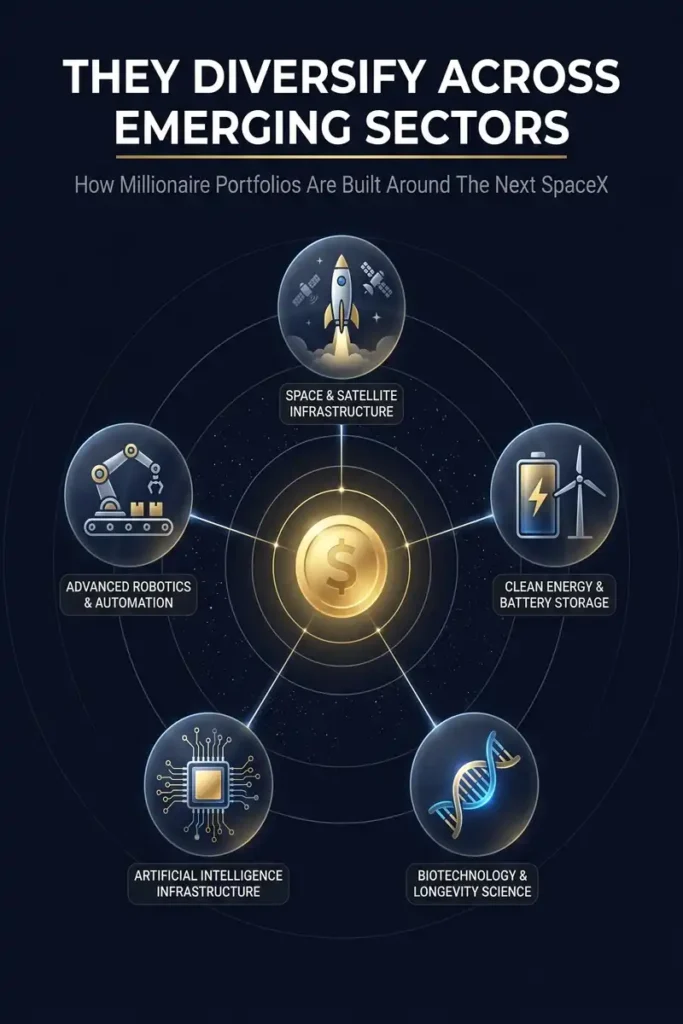
Millionaires rarely place all their capital into a single “next SpaceX” bet. Instead, they build diversified portfolios across several emerging sectors that share similar founder psychology profiles:
- Space and satellite infrastructure — companies building on reusable launch technology
- Clean energy and battery storage — companies solving grid-scale energy problems
- Biotechnology and longevity science — companies targeting age-related disease
- Artificial intelligence infrastructure — companies building compute and chip capacity
- Advanced robotics and automation — companies replacing manual labor at scale
They Use Structured Investment Vehicles
Rather than picking individual stocks, sophisticated investors often access these sectors through venture funds, growth equity funds, or thematic ETFs that track emerging technology indices. This structure spreads risk across dozens of companies instead of concentrating capital in one founder’s vision. You can review how professional fund managers construct thematic portfolios through BlackRock’s megatrends investment framework, which many family offices reference when they build long-term allocation strategies.
They Track Founder Mental Endurance, Not Just Revenue
Wealthy investors increasingly hire behavioral analysts to assess founder resilience before they commit capital, because mental endurance predicts the SpaceX mindset far more reliably than a pitch deck does. This trend mirrors what I discuss in my article on cortisol and trading psychology, where I explain how stress hormone regulation predicts long-term decision quality far better than short-term performance data.
Future Investment Trends For 2026 And Beyond
The investment landscape shifts every year, but four trends currently dominate how millionaires and family offices plan capital deployment heading into the next decade.
Private Markets Outpace Public Markets
More capital now flows into private equity and venture capital than into public stock markets among ultra-high-net-worth investors. Private markets let investors access companies before they go public, capturing the steepest growth curve during a company’s earliest years.
Space Economy Investment Accelerates
The commercial space sector now attracts billions in annual private investment, driven by falling launch costs and growing satellite demand. Investors increasingly treat space infrastructure the way they treated internet infrastructure in the 1990s: as a foundational layer that will support dozens of future industries.
AI Infrastructure Becomes The New Oil Pipeline
Investors compare current AI chip and data center investment to the oil pipeline boom of the early twentieth century. Companies that control compute capacity now attract valuations that rival entire national economies.
Longevity Science Draws Founder-Level Ambition
Biotech founders increasingly apply the same SpaceX mindset that Musk applies to rockets, targeting problems like cellular aging and organ regeneration. Investors who understand this mindset recognize this sector as the next frontier for SpaceX-level ambition.
Building The SpaceX Mindset: Practical Steps For Founders And Investors
You do not need to launch rockets to apply the SpaceX mindset to your own goals. Whether you want to build a company or invest in one, you can train the same cognitive patterns that drive massive success.
For Aspiring Founders
- Set a goal that feels 80% impossible. Your brain releases more dopamine when you chase a stretch goal instead of a comfortable target.
- Build a financial buffer before you take risks. Musk funded SpaceX with liquid capital, which let him make bold decisions without panic.
- Train your stress response daily. Techniques like the 4-7-8 breathing method, which I cover in detail in my breathing protocol for high-pressure decision-making, help regulate cortisol during high-stakes moments.
- Surround yourself with pattern-recognition mentors. Founders who scale fastest usually study multiple industries, not just their own.
For Aspiring Investors
- Study founder psychology before you study spreadsheets. Financial metrics change monthly; the SpaceX mindset predicts decade-long outcomes far better than a single quarter’s revenue.
- Diversify across emerging sectors rather than single companies. Spread risk across space, energy, biotech, and AI infrastructure.
- Track your own decision-making biases. I break down how heart rate variability affects investment judgment in my article on HRV and trading psychology, which applies directly to long-term portfolio decisions as well.
- Work with a licensed financial advisor. No article, including this one, replaces personalized financial planning based on your actual risk tolerance and net worth.
The Hidden Cost Of The SpaceX Mindset
Every founder who builds a company like SpaceX pays a psychological cost that rarely appears in headlines. Musk has spoken publicly about the toll extreme work schedules take on his mental health. Founders who carry the SpaceX mindset often sacrifice sleep, relationships, and baseline stress regulation in pursuit of their vision.
This is why I always pair ambition psychology with recovery protocols on this site. You can build a company or a portfolio that changes the world, but you cannot sustain that pace without protecting your baseline mental health. I recommend readers assess their own stress load using tools like my cognitive health age calculator, which tracks how chronic stress and poor sleep accelerate biological aging regardless of your bank balance.
Conclusion: You Do Not Need A Rocket To Build The SpaceX Mindset
You can apply the SpaceX mindset to any goal, whether you build a company, manage a trading portfolio, or grow a medical practice. The dopamine-driven ambition that built SpaceX runs on trainable brain circuits, not magic. Millionaires who consistently invest in the next massive company understand this mindset as deeply as they understand balance sheets.
Start small. Set one goal that feels 80% impossible. Track your stress response while you chase it. Study the founders who came before you, and let their documented failures teach you as much as their successes. The next SpaceX-level company will emerge from someone applying the SpaceX mindset right now, and understanding it puts you one step closer to recognizing — or becoming — that founder.
Medical Disclaimer
This article provides general educational information about psychology, neuroscience, and investment trends. It does not constitute medical advice, psychiatric treatment, or financial advice. Dr. Nirosh is a licensed physician, but this content does not replace a one-on-one consultation with a qualified healthcare provider, licensed therapist, or certified financial advisor. Always consult a licensed medical professional before making decisions related to your mental health, and always consult a licensed financial advisor before making investment decisions. Individual results vary, and past performance of any company or investment does not guarantee future results.
Contact Us
Have questions about the psychology of high performance, trading cognition, or biohacking strategy? Reach out to the team at TheDopamineDoc:
- Website: www.thedopaminedoc.com
- Email: contact@thedopaminedoc.com
- Follow us: The Dopamine Doc on Facebook for daily insights on performance psychology and cognitive health
We read every message and respond within two business days.