Introduction
Imagine you just took a heavy loss. Initially, you stared at the charts, confident in your setup, but the market moved violently against you. Suddenly, a flush of heat hits your face, and your heart rate spikes. Consequently, you feel an overwhelming urge to jump back in immediately to make that money back. This phenomenon is known as revenge trading.
It is the single fastest way to blow up a trading account. Most traders believe this is merely a discipline problem. However, as a doctor, I can tell you it is actually a biological problem. You are fighting millions of years of evolution. In fact, your brain perceives a financial loss exactly like a physical threat. We call this the “Amygdala Hijack.”
While many look for the revenge trading meaning in financial terms, the real answer lies in neuroscience. Understanding the biology behind revenge trading transforms how you handle losses. Therefore, you stop fighting yourself. Instead, you start managing your biology.
I also had a bad experience of trading. I first felt the “red mist” after a sudden loss in forex trading. My trade hit stop loss, and I felt angry and rushed to enter another trade to recover the money. Unfortunately, I ignored my strategy and lost again. That moment taught me how emotions can destroy good trading decisions.
Defining the Beast: What is the True Revenge Trading Meaning?
If you search for revenge trading Investopedia, you will find a standard definition: attempting to recoup losses by entering new trades irrationally. However, that definition is incomplete because it describes the action, not the cause.
While we are looking at the biological cause, it is also helpful to understand the financial side of these biases by exploring Investopedia’s Guide to Behavioral Finance.
The true revenge trading meaning is a state of physiological arousal where the emotional center of the brain overrides the logical center. Deep inside your temporal lobes lies an almond-shaped structure called the amygdala. It acts as the brain’s alarm system. Specifically, it detects fear and threats. For example, when a saber-toothed tiger chased our ancestors, the amygdala triggered the “fight or flight” response.
The Amygdala vs. The Prefrontal Cortex
Today, we do not face tigers. We face red candles and stop-losses. However, your brain cannot tell the difference. When you lose money, the amygdala screams “Danger!” Consequently, it hijacks control from the prefrontal cortex. The prefrontal cortex handles logic, planning, and risk management.
Traders globally suffer from this. Whether someone is searching for revenge trading meaning in Hindi or revenge trading adalah in Indonesia, the biological reaction is identical. The pain of loss is a universal human experience that transcends language.
Once the hijack occurs, your IQ effectively drops. As a result, you cannot think clearly. You only feel the need to fight the threat. In the market, “fighting” looks like doubling your position size or entering a trade without a setup. This is the physiological birth of revenge trading.
The physiological mechanism of this ‘fight or flight’ response is well-documented in medical literature; you can learn more about the Amygdala Hijack and emotional processing here
Learning from the Community: Revenge Trading Reddit Stories
You are not alone in this struggle. If you browse revenge trading Reddit threads, you will see thousands of traders sharing identical horror stories. They describe a “blackout” moment. One minute they are following a plan; the next, they have blown 50% of their account on a single impulsive trade.
These stories highlight a crucial symptom: the loss of control. Revenge trading rarely happens without warning signs. Furthermore, your body gives you clues before you click that “buy” button.
- Physical agitation: You might tap your foot aggressively or clench your jaw.
- Tunnel vision: You ignore broader market context and stare at the 1-minute chart.
- Internal dialogue: You start saying things like, “The market owes me,” or “I just need to get back to breakeven.”
If you notice these symptoms, you are already in a state of high arousal. Your cortisol levels are rising. Cortisol is the stress hormone. High cortisol blocks rational thinking. Consequently, you enter a “tilt” state. Continuing to trade in this state guarantees you will fall victim to revenge trading.
I noticed these signs clearly in my close friend who is a freelancer and trades crypto at night after work. One evening, after a losing trade, he started tapping his foot nonstop and clenching his jaw. His eyes were locked on the 1-minute chart, ignoring the bigger market trend we had discussed earlier. I heard him say, “The market owes me. I just need one good trade to get back to breakeven.” At that moment, his thinking had changed. He was stressed, restless, and emotional. I knew his cortisol was high and he was already in a tilt state. I advised him to stop trading, but he continued and lost more. That experience showed me how physical stress signals are an early warning sign of revenge trading.
Why We Rage-Trade: The Dopamine Trap
Why do we specifically choose to trade again? Why not just walk away? The answer lies in dopamine. Winning a trade releases dopamine, the “feel-good” neurotransmitter. Conversely, losing triggers a sudden drop in dopamine levels. This drop feels painful
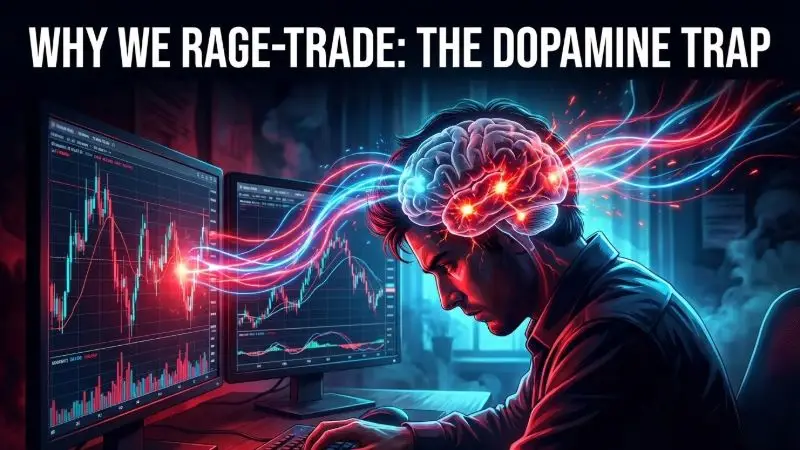
Your brain desperately wants to restore that dopamine baseline. It knows that a winning trade will fix the chemical imbalance. Therefore, it pushes you toward revenge trading to get that quick fix. You are not just chasing money; you are chasing a neurochemical hit.
Addiction psychiatrists see this pattern in gamblers. The urge to “chase losses” drives the behavior. Revenge trading operates on the exact same neural pathways. Essentially, you are fighting a chemical withdrawal symptom.
If you find yourself constantly chasing this neurochemical high, you should read my deep dive on How to Perform a Dopamine Detox for Traders to reset your brain’s reward system.
The Critical Distinction: Revenge Trading vs Comeback
There is a fine line between recovering a loss and raging at the market. Understanding the difference between revenge trading vs comeback is vital for your long-term survival.
A “comeback” is strategic. It involves:
- Accepting the loss.
- Stepping away to reset.
- Waiting for a high-probability setup that matches your original plan.
In contrast, revenge trading is immediate and emotional. It ignores the plan. Famous revenge trading quotes often highlight this folly, such as, “The market is a device for transferring money from the impatient to the patient.” When you revenge trade, you are the impatient one donating your capital.
Medical Strategies to Stop Revenge Trading
Now that we understand the pathology, let’s discuss the treatment. You cannot simply “willpower” your way out of an amygdala hijack. Instead, you need physiological interventions to break the cycle of revenge trading.
1. The Pattern Interrupt
The moment you feel the urge to rage-trade, you must physically shock your system. You need to snap the amygdala out of its loop.
- Stand up immediately. Do not sit there.
- Change your temperature. Splash cold water on your face. This triggers the “mammalian dive reflex,” which lowers your heart rate.
- Walk away from the screen. Leave the room entirely.
2. The 4-7-8 Breathing Technique
Your breath connects directly to your autonomic nervous system. Rapid breathing signals danger. Slow breathing signals safety. To stop the onset of revenge trading, use this method:
- Inhale through your nose for 4 seconds.
- Hold the breath for 7 seconds.
- Exhale audibly through your mouth for 8 seconds.
This activates the parasympathetic nervous system. It tells your amygdala, “We are safe. The tiger is gone.” Logic returns to the prefrontal cortex.
I use breathing techniques often during high-stress medical situations to stay calm and focused. The same method helps me in trading. When I feel tension after a loss, I do the 4-7-8 breathing once or twice before looking at the chart again. It quickly slows my heart rate and clears my mind. Once my body feels calm, I can think logically and avoid revenge trading.
This technique is not just for traders; it is widely recommended by sleep experts and physiologists. You can see the full medical breakdown of How 4-7-8 Breathing Reduces Anxiety from the Cleveland Clinic.
Designing a Protocol to Prevent Revenge Trading
Prevention is better than cure. You need a trading plan that accounts for your biology. Revenge trading thrives in chaos. Structure kills it.
Set a Hard Stop-Loss for the Day Define a maximum daily loss limit. If you lose that amount, your broker should lock you out. This removes the decision-making process from your emotional brain.
Limit Your Screen Time The longer you stare at charts, the more decision fatigue sets in. A tired prefrontal cortex cannot resist the amygdala. Consequently, revenge trading becomes more likely after long sessions. Trade for 1-2 hours, then stop.
Journal Your Emotional State Before every trade, rate your emotional state from 1 to 10. If you feel angry, frustrated, or overly excited, do not trade. This simple check-in brings awareness back to the logical brain.
Conclusion
Revenge trading is not a sign that you are a bad trader. It is a sign that you are human. Your brain evolved to survive threats, not to trade crypto or forex. The amygdala hijack is a powerful force. However, you possess the tools to counteract it.
Recognize the physical signs of stress. Understand that the urge to trade is just a dopamine craving. Use physiological hacks like cold water and breathing exercises to regain control.
Mastering your biology is the ultimate edge. The market will always be there. Ensure your capital is still there too by eliminating revenge trading from your routine. Discipline is not just a mindset; it is a biological practice you train every day.
Medical Disclaimer The information provided in this article is for educational and informational purposes only and does not constitute medical advice, diagnosis, or treatment. Always seek the advice of a qualified healthcare provider with any questions you may have regarding a medical condition or mental health concern. The trading strategies discussed involve risk and are not financial advice.
Author: Dr. Nirosh
Pingback: The Winner’s Effect: Why Overconfidence Kills Accounts - TheDopamineDoc