Trading requires intense focus. However, your body often pays the price. You sit for hours analyzing charts. Eventually, your lower back starts to ache. You might ignore it at first. But this pain can ruin your trading performance. The likely culprit is a condition called Lower Cross Syndrome.
I remember a specific week where the market was volatile. My friends and I were glued to our screens for 10 hours a day. By Friday, none of us could stand up straight without groaning. We realized our focus on the charts was destroying our posture.
This guide explains why traders suffer from this issue. You don’t need to download a complex lower cross syndrome exercises pdf or watch a boring lower cross syndrome ppt presentation. We will explore simple fixes right here to get you back to peak performance.
What is Lower Cross Syndrome?
Lower Cross Syndrome is a muscular imbalance in your lower body. It happens when certain muscles become tight while others become weak. Think of it as a tug-of-war in your pelvis.
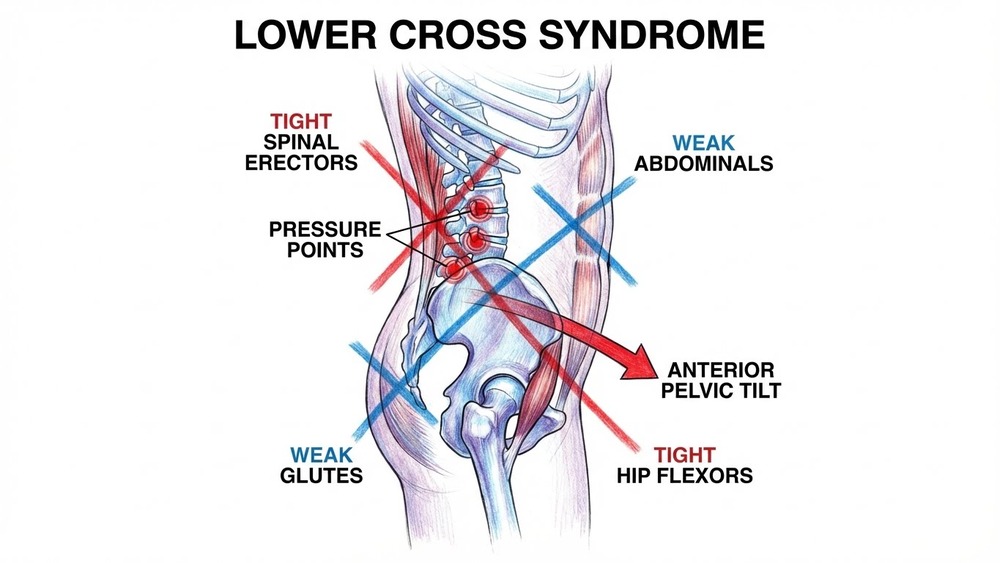
If you look at a standard lower cross syndrome diagram, you will see a diagonal line of tightness crossing a diagonal line of weakness. Specifically, the lower cross syndrome muscles involved are the hip flexors and spinal erectors (tight) versus the abdominals and glutes (weak). Consequently, your pelvis tilts forward. Doctors call this an anterior pelvic tilt. This tilt puts massive pressure on your lumbar spine.
A Note for the Medical Minded
As a doctor, I often get asked about the technical side. While there is no specific single lower cross syndrome ICD 10 code (it usually falls under biomechanical lesions like M62.8), the pattern is clinically distinct. It is also important to distinguish it from lower cross syndrome type b, a variation involving different muscle firing patterns, though the classic anterior tilt is what most traders experience.
Why Traders Develop Lower Cross Syndrome
The trading lifestyle is the perfect storm for this condition. The human body is designed for movement, not for static endurance.
The Sitting Trap
Sitting is the new smoking. When you sit, your hips are in a constantly flexed position. Over time, your hip flexors shorten and tighten. They pull your pelvis forward even when you stand up. This is the root cause of Lower Cross Syndrome.
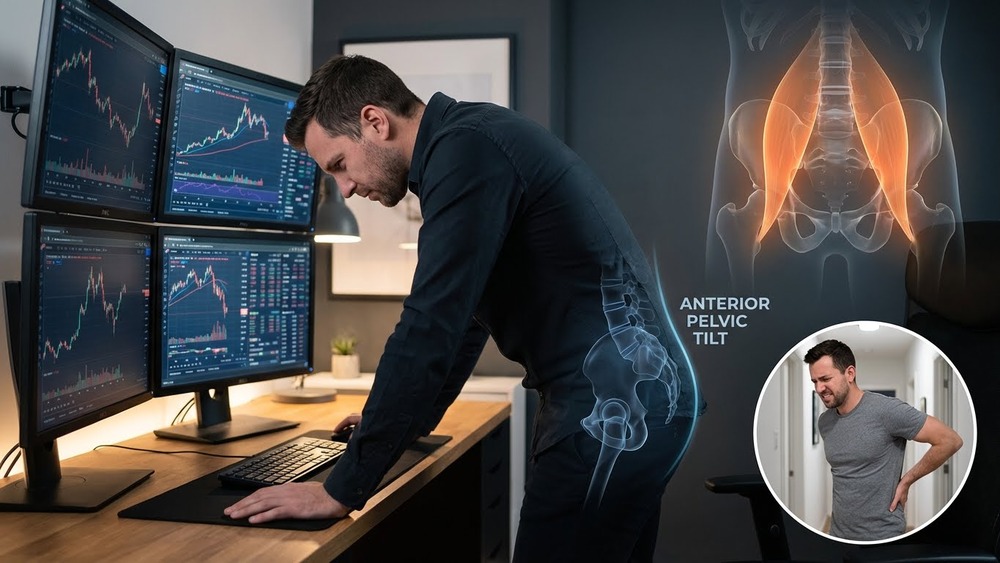
My friend Sanju is a great example. He sits perfectly still while scalping. But when he stands up to grab a coffee, he walks stiffly for the first few minutes. That is his hip flexors refusing to let go.
Weak Glutes
While your hip flexors work overtime, your glutes do nothing. You are literally sitting on them. Muscles atrophy when you do not use them. Weak glutes cannot pull your pelvis back into a neutral position. Therefore, the tight hip flexors win the tug-of-war. This imbalance solidifies Lower Cross Syndrome in your body.
Stress and Posture
Trading is stressful. When a trade goes against you, you tense up. You might hunch your shoulders or tighten your core incorrectly. This stress adds tension to your lower back. Combined with sitting, it creates a cycle of pain. Lower Cross Syndrome thrives on this physical and mental tension.
Identifying Lower Cross Syndrome Symptoms
How do you know if you have it? Pain is the most obvious sign, but there are specific lower cross syndrome symptoms to watch for.
- Swayback: Your lower back curves excessively inward (hyperlordosis).
- Protruding Belly: Your stomach sticks out, even if you are thin, due to the pelvic tilt.
- Hip Pain: You feel tightness at the front of your hips.
- Knee Pain: Sometimes, the imbalance affects your knee alignment.
If you see these signs in the mirror, Lower Cross Syndrome is likely affecting you.
Fixing Lower Cross Syndrome for Better Trading
You cannot quit trading. But you can fix your body. Treating this issue requires a two-step approach using specific lower cross syndrome exercises: stretch the tight muscles and strengthen the weak ones.
Step 1: Stretch the Tight Muscles
You must release the tension in your hip flexors.
- Lunge Stretch: Kneel on one knee. Push your hips forward gently. You will feel a stretch in the front of your hip. Hold for 30 seconds.
- Pigeon Pose: This yoga pose opens the hips deeply. It targets the deep rotators and flexors.
Do these stretches before your trading session. They tell your body to relax before the stress begins.
Step 2: Strengthen the Weak Muscles
Stretching alone will not fix Lower Cross Syndrome. You must build strength to hold your pelvis correctly.
- Glute Bridges: Lie on your back with knees bent. Lift your hips toward the ceiling. Squeeze your glutes at the top. This exercise wakes up your sleeping muscles.
- Planks: A strong core protects your spine. Planks train your abs to stabilize your body.
I started doing 20 glute bridges every morning before checking the Asian session open. It took about two weeks, but that nagging ache in my lower back finally disappeared.
Ergonomics: Your Trading Battlestation
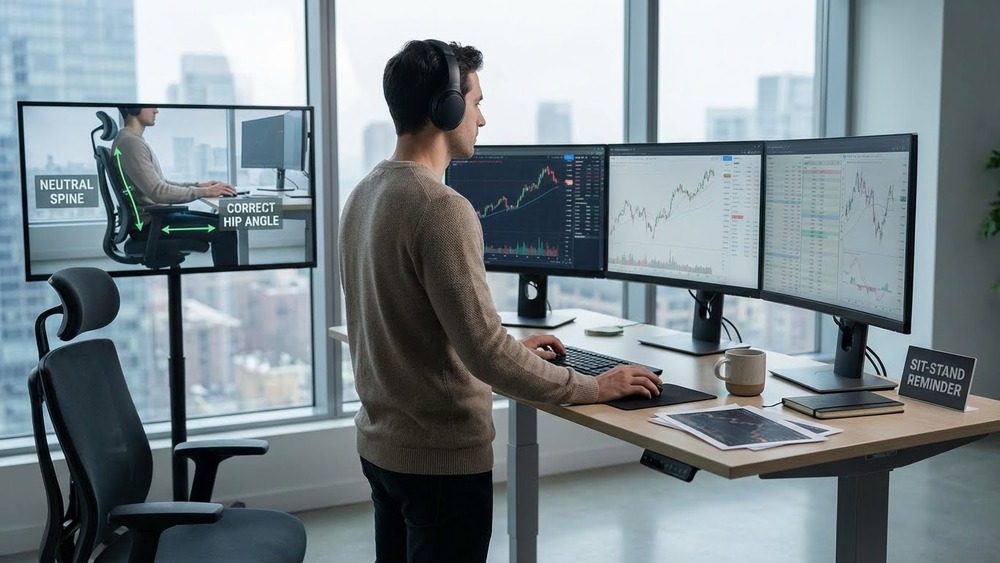
Your environment matters. A bad chair invites Lower Cross Syndrome into your life.
- Adjust Your Seat: Ensure your hips are higher than your knees. This opens the hip angle.
- Monitor Height: Keep your screens at eye level. This prevents you from leaning forward.
- Stand Up: Use a standing desk if possible. Alternating between sitting and standing is the ultimate cure.
Small changes yield big results. Treat your trading setup like a cockpit. It must support your body, not harm it.
Long-Term Prevention
Consistency is key. You cannot fix Lower Cross Syndrome in a day. You must make movement a habit. Set a timer on your trading platform. Every hour, stand up and stretch. Walk around the room.
Furthermore, go to the gym. Compound movements like deadlifts and squats strengthen your posterior chain. A strong back and glutes are your best defense against Lower Cross Syndrome.
Why Health Equals Wealth in Trading
Many traders focus only on strategy. They forget the machine that executes the strategy: their body. If you are in pain, you lose patience. You make impulsive decisions. Lower Cross Syndrome is a silent capital killer.
By fixing your posture, you improve blood flow to your brain. You maintain mental clarity longer. Therefore, physical health directly correlates with trading profits. Do not let a tight back ruin a good trade setup.
Essential Resources
Here are three high-quality resources to help you understand and manage this condition:
- Physiopedia – Lower Crossed Syndrome: This is a comprehensive medical database. It explains the exact lower cross syndrome physiopedia mechanics for those who want a deeper technical understanding.
- Healthline – Anterior Pelvic Tilt Exercises: This article provides a visual guide to fixing the pelvic tilt. It offers varied exercises that specifically target the root cause of Lower Cross Syndrome.
- National Academy of Sports Medicine (NASM) – Corrective Strategies: NASM is a gold standard in fitness. This page details professional corrective strategies that athletes and desk workers use to reverse Lower Cross Syndrome.
Conclusion
Lower Cross Syndrome is common among traders, but it is not inevitable. You have the power to fix it. Stretch your hips, strengthen your glutes, and optimize your workspace. Your back will thank you. More importantly, your P&L will likely improve as your focus returns. Start addressing Lower Cross Syndrome today and trade pain-free.
Medical Disclaimer
The information provided in this article regarding Lower Cross Syndrome and associated exercises is for educational purposes only. It is not intended as a substitute for professional medical advice, diagnosis, or treatment. Always seek the advice of your physician or other qualified health provider with any questions you may have regarding a medical condition. Never disregard professional medical advice or delay in seeking it because of something you have read on this website.
Author: Dr. Nirosh
Dr. Nirosh is a medical doctor and active trader who specializes in the physical and mental health challenges faced by traders, gamers, and desk professionals. He combines clinical medical knowledge with real-world trading experience to create practical, evidence-based solutions that improve performance and reduce pain.
👉 Read Dr. Nirosh’s full bio