
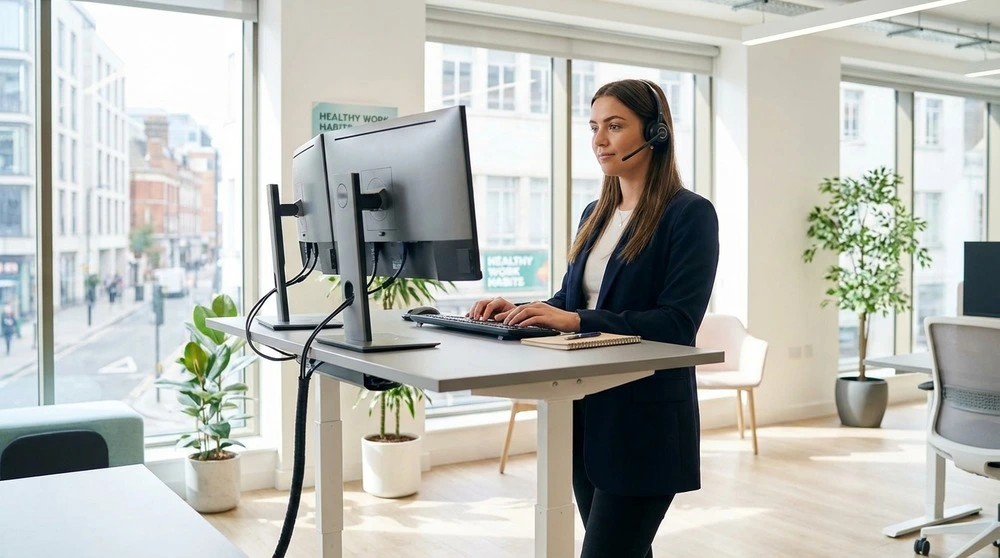
As a medical doctor, I often see patients misusing the standing desk protocol, which leads to back pain, leg fatigue, and poor focus during long desk hours.
At first, most people think standing all day is healthy.
However, that belief often creates new problems.
In this article, I explain a doctor-approved standing desk protocol in a clear and safe way.
More importantly, I show how long to stand, when to sit, and how to protect your body while working.
As a result, you can improve focus without adding pain.
Standing improves circulation.
At the same time, standing increases alertness.
Still, standing without balance causes discomfort.
In my experience, I had no clear system at first. I stood too long. Because of that, my legs burned and my back tightened. My friends who trade, game, and code faced the same problem.
Understanding the Core Idea Behind Standing Desks
A standing desk works best when used as part of a balanced daily routine.
It should not replace sitting completely.
Instead, it should support movement.
So you need to know about standing desk protocol.
This approach focuses on three things:
- Timing
- Movement
- Recovery
Think of your body like a fuel system.
When you sit too long, one system slows down.
On the other hand, standing too long drains another system.
Movement, however, refuels both.
Because of this, balance keeps energy steady.
How Long Should You Stand at a Desk?
This is one of the most common questions I hear.
Naturally, people want a clear number.
Doctors do not recommend standing all day.
Instead, research supports short and planned standing periods.
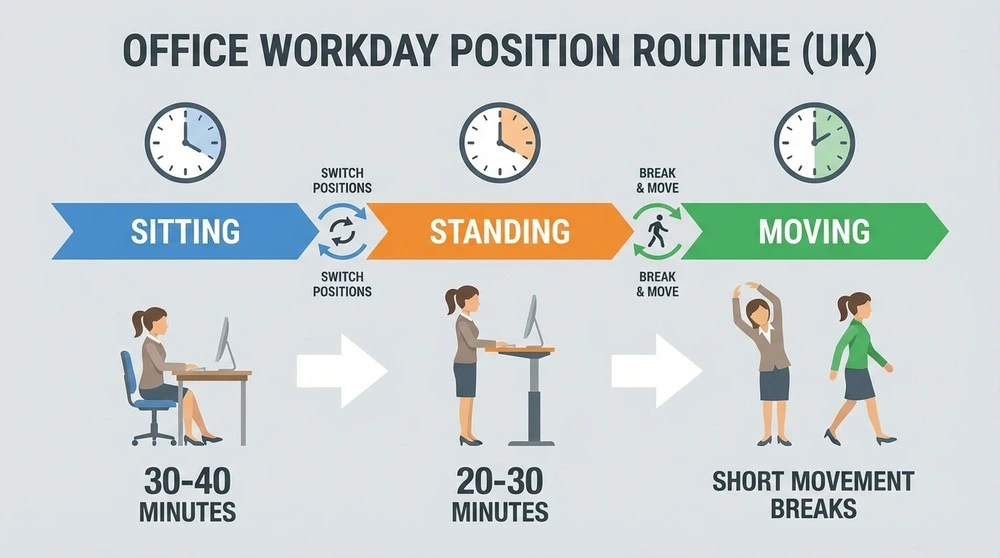
Recommended Daily Timing
- Stand for 20–30 minutes
- Then sit for 30–40 minutes
- After that, move for 3–5 minutes
Repeat this pattern during the day.
As a result, circulation improves.
At the same time, posture feels more relaxed.
Focus also lasts longer.
For example, one of my friends who trades full-time stood for eight hours a day. Because of that, his calves cramped badly. After switching to this routine, his pain reduced within a week.
Why Standing Too Long Creates New Problems
Standing feels active.
However, staying upright for long hours stresses the body.
Prolonged standing increases pressure on:
- Knees
- Ankles
- Lower spine
- Foot arches
In addition, blood returns more slowly from the legs.
Because of this, swelling and heaviness appear.
NIH research confirms that prolonged standing increases muscle and joint strain.
👉 https://www.ncbi.nlm.nih.gov/pmc/articles/PMC4591921/
So, moderation matters more than effort.
Desk Setup and Posture Matter More Than Standing Itself
Many people blame standing for their pain.
In reality, posture causes most problems.
A poor desk setup increases strain.
Even worse, bad alignment cancels the benefits of movement.
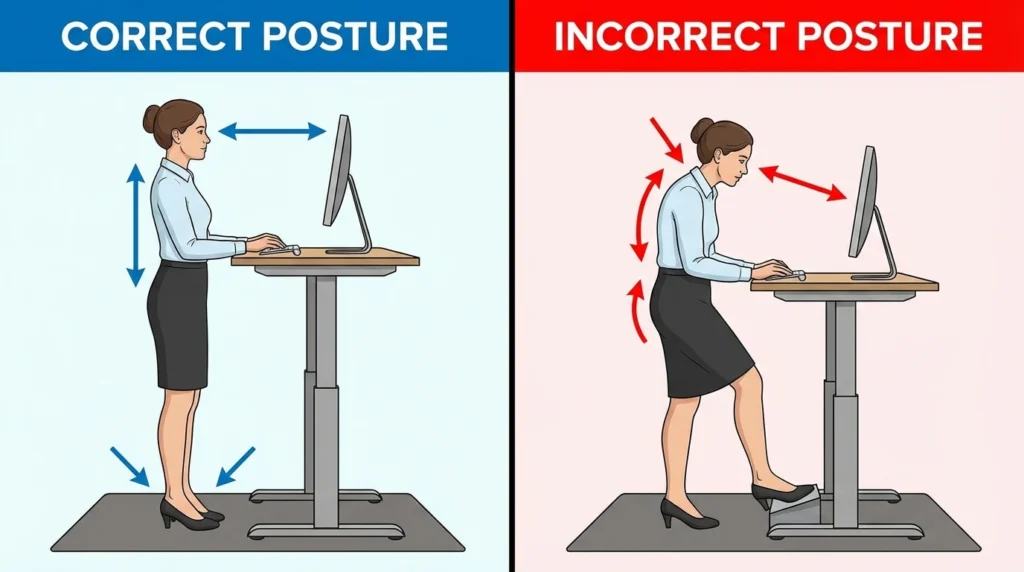
Basic Alignment Rules
- Keep elbows near 90 degrees
- Place the screen at eye level
- Relax your shoulders
- Keep feet flat on the floor
When alignment improves, discomfort drops.
The Neuroscience
Posture affects more than muscles.
It also changes how the brain works.
Your brain uses dopamine to stay focused.
This chemical starts in the ventral tegmental area.
It acts on the nucleus accumbens.
Think of dopamine as mental fuel.
Short posture changes increase alertness.
However, constant strain drains that fuel.
Over time, focus fades.
When dopamine drops:
- Attention weakens
- Irritability rises
- Mental fatigue appears
PubMed research confirms posture affects brain activation.
👉 https://pubmed.ncbi.nlm.nih.gov/23415512/
Signs Your Desk Routine Needs Adjustment
Your body sends warnings early.
You just need to notice them.
Common signs include:
- Lower back stiffness
- Foot pain
- Knee tightness
- Brain fog
When these appear, balance is off.
At first, I ignored these signs. My friends did the same. We believed discomfort meant progress. Later, we realized it meant overload.
Can This Approach Help Back Pain?
Yes, but only when done correctly.
Standing reduces spinal pressure for short periods.
Sitting allows recovery.
Meanwhile, movement restores circulation.
Together, these protect:
- The lower back
- Hip flexors
- Core muscles
Without balance, pain often returns.
Practical Protocols You Can Use Today
A Simple 3-Step Routine for Desk Work
This method is easy to follow.
It also requires no tools or medication.
- Sit during deep-focus work
- Stand during calls or reading
- Move briefly every hour
Because of this structure, fatigue drops.
NIH research shows regular movement improves mental endurance.
👉 https://www.ncbi.nlm.nih.gov/pmc/articles/PMC7700832/
Why Alternating Positions Improves Performance
No single posture fits the whole day.
Instead, variation protects the body.
Sitting restores leg circulation.
Standing boosts alertness.
Movement resets posture.
As a result, energy stays stable.
Sitting Is Not the Enemy
Sitting becomes harmful only when nonstop.
Otherwise, it plays an important role.
Sitting supports fine motor tasks.
It also allows spinal recovery.
Additionally, it reduces leg strain.
Balance always matters more than posture choice.
My Experience and My Friends’ Experience
Once I followed a balanced desk routine, my back pain reduced. My focus improved. My friends felt less leg fatigue. Eventually, we stopped competing over who could stand longer.
Consistency helped more than effort.
What the Science Supports
Harvard Health explains why posture changes reduce injury risk.
👉 https://www.health.harvard.edu/blog/the-truth-behind-standing-desks-2016092310264
The Mayo Clinic confirms proper alignment reduces strain.
👉 https://www.mayoclinic.org/healthy-lifestyle/adult-health/in-depth/posture/art-20045094
NIH links regular movement to better cognitive performance.
👉 https://www.ncbi.nlm.nih.gov/pmc/articles/PMC7700832/
Common Mistakes to Avoid
- Standing all day
- Locking the knees
- Ignoring foot pain
- Skipping movement
- Poor desk height
Avoiding these keeps pain away.
Doctor’s Orders: Key Takeaways
- Stand in short blocks
- Sit without guilt
- Move every hour
- Listen to pain
- Fix desk height
Balance always beats extremes.
Medical Disclaimer
This article is for educational purposes only. It does not replace medical advice, diagnosis, or treatment. Always consult a healthcare professional before making health changes.
Author
Dr. Gihan Nirosh Hasintha, MBBS (Sri Lanka)
Dr. Nirosh is a medical doctor and active trader who focuses on physical and mental health challenges faced by traders, gamers, and desk professionals. He combines medical knowledge with real-world experience to create practical, evidence-based solutions.
👉 Read Dr. Nirosh’s full bio
Question
How do you balance sitting and standing during your workday right now? Share your experience in the comments.