
As a medical doctor, I often see patients struggling with severe visual fatigue after spending hours in front of a monitor. Gamers constantly push their physical and mental limits to achieve peak performance. Consequently, many players experience headaches, dry eyes, and a sudden inability to track moving targets. You need to understand the underlying mechanisms of gamer eye strain to protect your vision. Therefore, this guide will break down exactly why your vision blurs and how you can fix it.
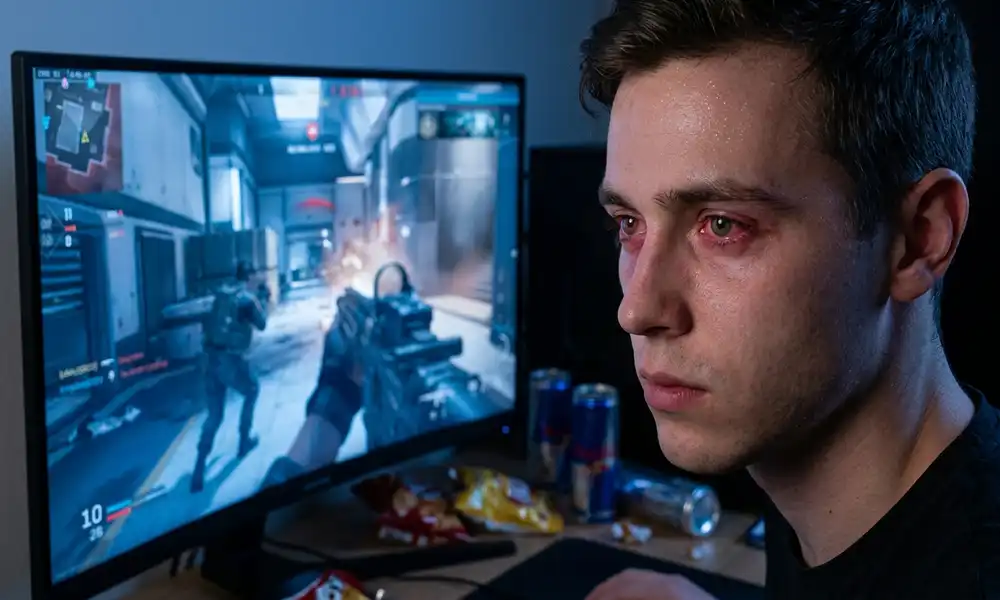
When my friends and I play story-driven games like Call of Duty or Mafia for hours, my eyes start to feel incredibly dry and heavy. We usually just ignore it and keep playing. However, the blurriness eventually ruins our aim and focus. I realized we needed a better way to play these long sessions without hurting our vision.
You cannot just ignore the pain and hope it goes away. Gamer eye strain actively degrades your reaction time. Furthermore, it disrupts your sleep cycle and triggers chronic headaches. We must examine the science behind this modern problem.
The Neuroscience of Gamer Eye Strain
To truly conquer gamer eye strain, you must understand your brain’s chemistry. Human eyes were not designed to stare at a fixed, glowing rectangle for eight hours straight. Instead, our ancestors used their vision to scan dynamic, distant horizons.
Think of your visual system like city traffic. Your neurotransmitters act as the fuel keeping the cars moving. Meanwhile, the synapses are the intersections where signals cross. When you play a highly stimulating video game, your brain floods the ventral tegmental area (VTA) and the nucleus accumbens with dopamine. This massive dopamine release creates intense hyper-focus.
However, this hyper-focus comes with a physical cost. High dopamine levels suppress your natural blink reflex. Normally, you blink about 15 to 20 times per minute. During an intense gaming match, that rate drops to just 3 or 4 blinks per minute. Consequently, the tear film on your cornea evaporates. This evaporation directly causes the burning sensation associated with gamer eye strain.
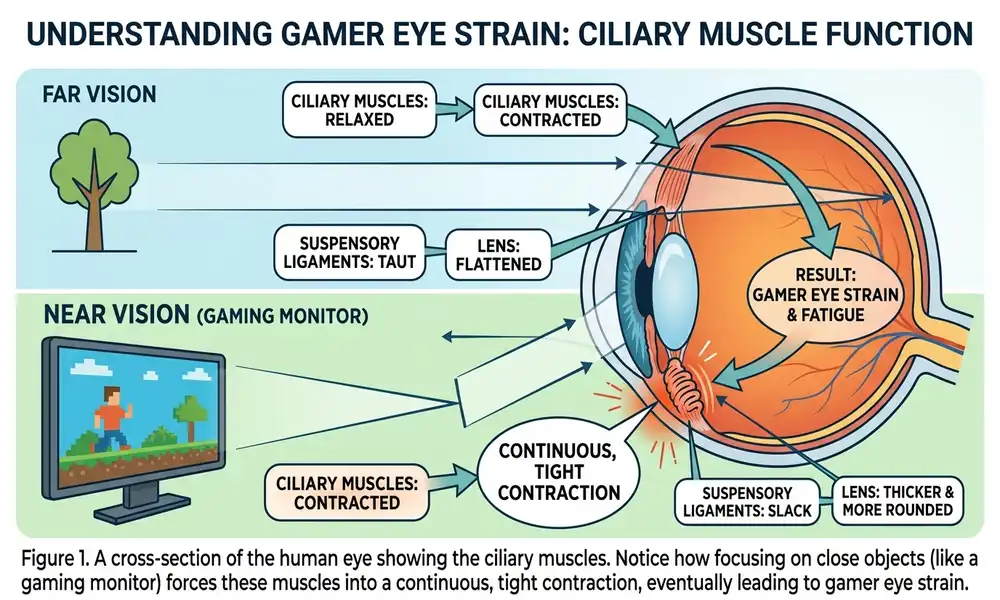
Furthermore, you must consider the ciliary muscles inside your eyes. These muscles control the shape of your lens to maintain focus. If you stare at a screen located two feet away, these muscles remain in a state of constant, rigid contraction. You can compare this to holding a heavy dumbbell halfway through a bicep curl for three hours. Eventually, the muscle fails. This exact mechanical failure leads to the blurry vision you experience late at night.
To learn more about how prolonged near-work affects the ciliary muscle, you can read this comprehensive study on digital eye strain from the National Institutes of Health (NIH). This research details the precise muscular fatigue that triggers visual discomfort.
Identifying the Symptoms of Gamer Eye Strain
You must recognize the warning signs early. Many players mistake gamer eye strain for general tiredness. However, specific symptoms indicate your visual system is failing.
- Photophobia: You become highly sensitive to bright light.
- Diplopia: You experience temporary double vision after looking away from the screen.
- Ocular Migraines: You feel a deep, throbbing pain directly behind your eyeballs.
- Scleral Redness: The white parts of your eyes become noticeably bloodshot.
If you experience these symptoms, you are actively damaging your baseline performance. Therefore, you must implement immediate changes to your routine.
My friend used to get massive headaches after our weekend gaming marathons. He thought he just needed more coffee. I told him his screen was too bright and his room was too dark. Once he fixed his lighting, his headaches stopped completely.
Additionally, visual fatigue often pairs with other behavioral issues. For example, poor visual health can shorten your attention span. If you find yourself constantly distracted, you might want to read my other article on understanding the mechanisms of Gaming Addiction and Focus.
Practical Protocols to Prevent Gamer Eye Strain
You do not need a prescription to fix this problem. Instead, you need discipline. I have developed a specific protocol to combat gamer eye strain. You can implement these three actionable steps today.
- The 20-20-20 Reset Protocol – You must manually override your suppressed blink reflex. Every 20 minutes, you need to look at an object 20 feet away for exactly 20 seconds. This simple action forces your ciliary muscles to relax. Furthermore, you should force yourself to blink deeply five times during this break to re-lubricate your cornea.
- Ambient Bias Lighting Setup – Never game in a pitch-black room. A bright monitor in a dark room forces your pupils to rapidly dilate and constrict. Consequently, this leads to massive muscular fatigue. You must place a soft, warm LED light behind your monitor. This bias lighting reduces the stark contrast between the screen and the surrounding wall. Thus, you significantly reduce the risk of gamer eye strain.
- Ergonomic Distance and Angle Calibration – You should position your monitor at least one arm’s length away from your face. Furthermore, the top of the monitor must sit exactly at eye level. This angle allows your upper eyelids to slightly cover your eyes. As a result, you minimize the exposed surface area of your eye, which prevents rapid tear evaporation.
For additional clinical data on optimizing screen ergonomics, review this peer-reviewed publication on visual ergonomics from PubMed. The study explains how specific viewing angles reduce mechanical stress on the eyes.
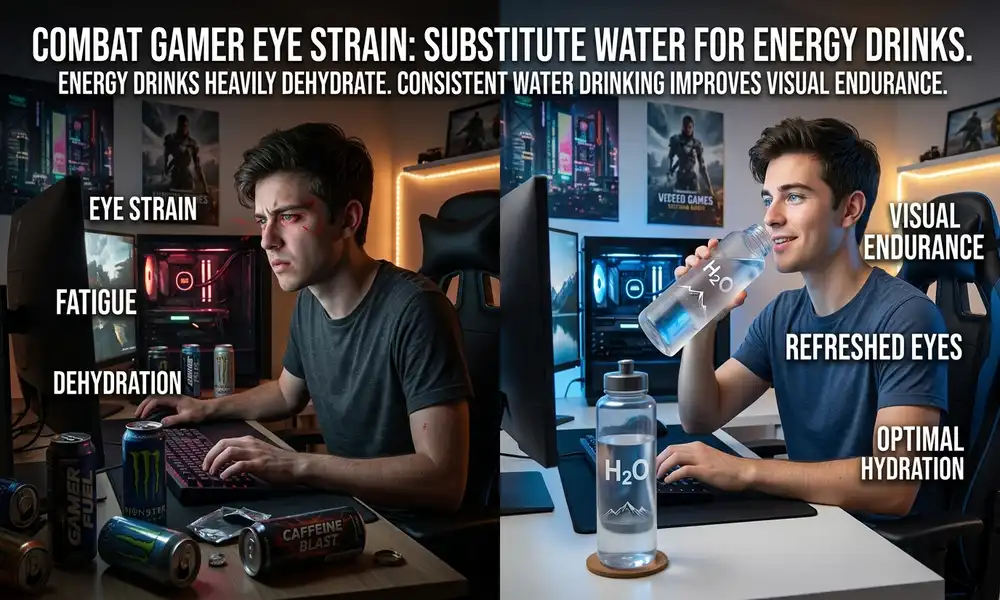
Finally, consider the role of hydration. Your body cannot produce tears if you lack total body water. You must drink water consistently during your gaming sessions. Energy drinks heavily dehydrate your system. Therefore, substituting water for energy drinks will drastically improve your visual endurance and combat gamer eye strain.
To explore how nutrition impacts your overall performance, check out this NIH resource on the link between systemic hydration and ocular surface health. Hydration truly serves as the foundation of your physical stamina.
Doctor’s Orders: Key Takeaways
You hold the power to protect your vision. Implement these strategies consistently to eliminate gamer eye strain.
- Acknowledge the biology: Gamer eye strain results from muscular fatigue and dopamine-induced blink suppression.
- Use the 20-20-20 rule: Break your visual lock every 20 minutes to reset your ciliary muscles.
- Optimize your environment: Install bias lighting and adjust your monitor distance immediately.
- Hydrate constantly: Drink water to maintain your tear film and prevent corneal dry-out.
Have you tried a dopamine detox or changed your lighting setup to stop gamer eye strain? Let me know in the comments below!
Author Bios:
Dr. Nirosh is a medical doctor and active trader who specializes in the physical and mental health challenges faced by traders, gamers, and desk professionals. He combines clinical medical knowledge with real-world trading experience to create practical, evidence-based solutions that improve performance and reduce pain. 👉 Read Dr. Nirosh’s full bio
Medical Disclaimer: The following article is for educational and informational purposes only. It is not a replacement for professional medical advice, diagnosis, or treatment. Always consult with a qualified healthcare provider regarding any medical condition or vision problems.