
Somewhere in New Jersey today, a 39-year-old man who has already won every major honor the sport can offer is about to walk onto a field and try to do it one more time — against a 19-year-old he once held as a baby. That’s the real subject of this article. The World Cup final is just the case study.
If you came here purely for kickoff time and how to watch, I’ve got you covered below — it’s the top of the funnel and I respect that. But the reason this particular match matters on a site built around dopamine, performance psychology, and the neuroscience of high-stakes decision-making is bigger than the scoreline. Today’s fifa world cup 2026 final between Spain and Argentina is, whether you follow football or not, one of the purest live demonstrations you’ll ever see of how the human brain handles pressure, aging, expectation, and irreversible outcomes — the exact same circuitry that governs a trader watching a position swing against them, an athlete stepping onto a starting line, or you, staring at an inbox before a decision you can’t take back.
Let’s use it as the lens it deserves to be.
The Essentials
- Match: Spain vs Argentina — FIFA World Cup 2026™ Final
- Kickoff: 3:00 p.m. ET / 12:00 p.m. PT / 19:00 GMT, Sunday, July 19, 2026
- World cup final location: New York New Jersey Stadium (MetLife Stadium), East Rutherford, New Jersey
- How to watch: FOX and FOX One in the U.S., with live streaming via the FOX Sports app; your national broadcaster elsewhere
- The matchup: Reigning champions Argentina (South American champions) vs. Spain (European champions) — the first meeting of continental title-holders in a World Cup final in 60 years
Now, onto the part that actually matters.
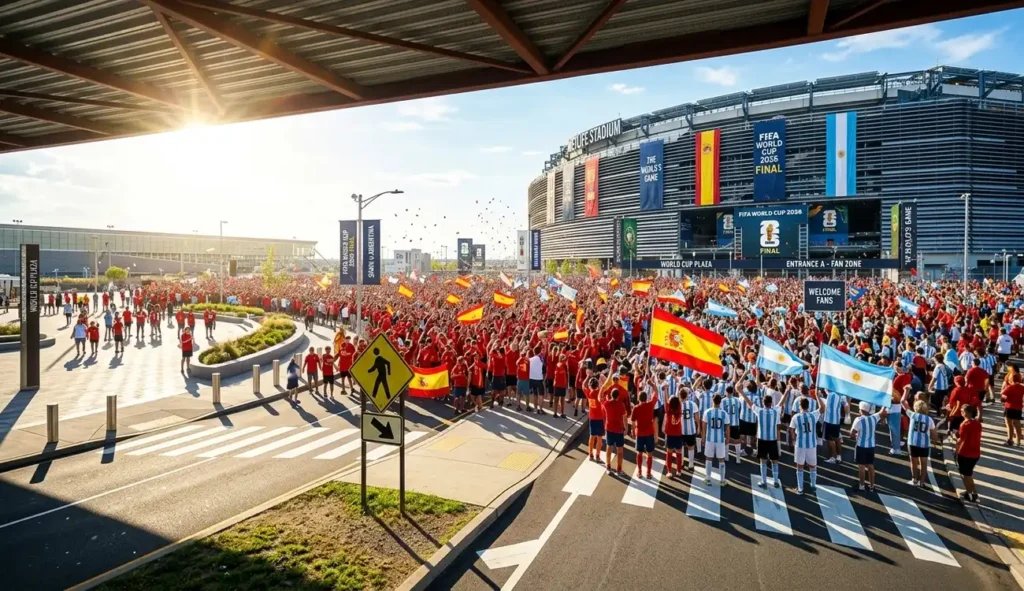
Why a Final Hijacks Your Dopamine System — Even If You Don’t Care About Football
Here’s a common misconception worth correcting before anything else: dopamine is not primarily a “pleasure” chemical. It’s a prediction chemical. Decades of neuroscience research on reward circuitry show that dopamine neurons fire most intensely not at the moment you get something good, but during the window of uncertainty before you know whether you’re going to get it. The bigger the uncertainty and the higher the stakes, the sharper that anticipatory firing becomes.
A World Cup final is, structurally, one of the most efficient anticipation machines the human species has ever built. Single elimination. No rematch. No “we’ll get them next season.” Ninety minutes, plus whatever it takes beyond that, and then a result that cannot be revised. If you’ve noticed your own heart rate creeping up simply reading storylines about a match you have zero financial or personal stake in, that’s not an overreaction — that’s your dopaminergic prediction system doing exactly what it evolved to do, just repurposed by a sport instead of a genuine survival threat.
This matters beyond football. It’s the same circuitry that fires when a trader is sitting on an open position ahead of a Fed announcement, or when you’re waiting on a diagnosis, a job offer, or an exam result. Understanding that the discomfort of not knowing is itself a neurochemical event — not a character flaw, not something to white-knuckle through in silence — is one of the more useful reframes in performance psychology. The anticipation you feel before kickoff today is, biologically, close cousin to the anticipation a swing trader feels before market open. Recognizing the shared mechanism is the first step to managing it in either context.
Two Case Studies in Performing Under Radically Different Pressure
What makes today’s final an unusually rich case study is that it puts two opposite performance-psychology profiles on the same pitch at the same time.
The Aging Elite Performer: Messi at 39
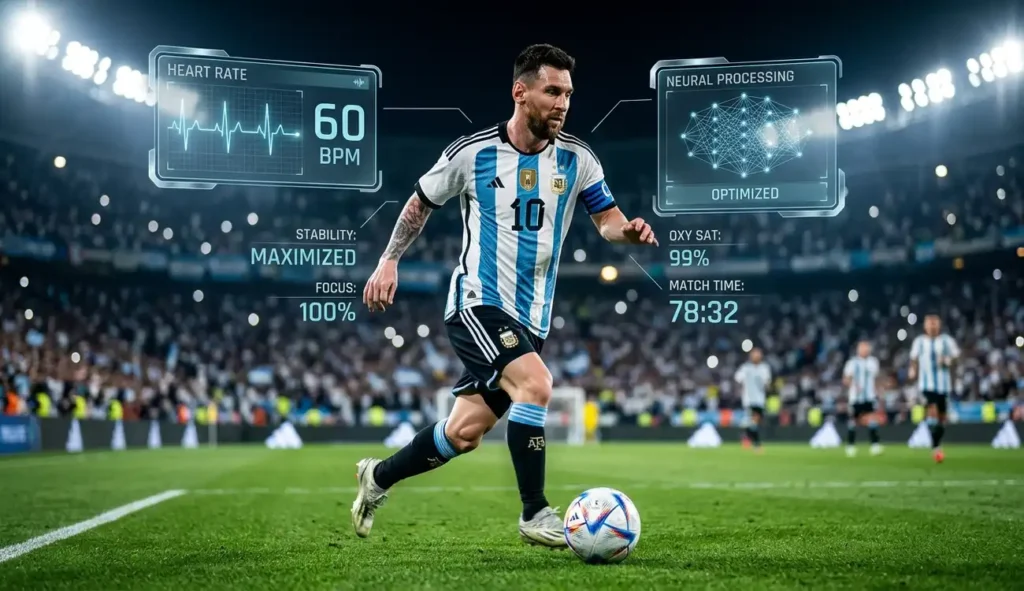
Lionel Messi is set to become the oldest outfield player to ever feature in a World Cup final. He’s also, by every account from this tournament, the Golden Boot frontrunner with eight goals and four assists, and the emotional engine behind Argentina’s habit of finding late, dramatic winners — most recently in a comeback semifinal victory over England.
From a performance-science standpoint, what’s happening with Messi at this stage of his career is genuinely instructive. Elite performers who sustain output into the back half of their careers typically aren’t relying on the same physical tools they had at 25. They’re compensating with pattern recognition built over decades, more efficient decision-making under time pressure, and — critically — a recalibrated relationship with the outcome itself. Athletes and high performers who’ve “seen it all” before often report less outcome-anxiety in must-win moments than younger competitors, not more, precisely because their nervous system has more prior data suggesting they can handle whatever the moment throws at them. That’s not talent. That’s earned neurological confidence, built one high-stakes rep at a time — a principle that applies just as directly to a trader’s tenth market crash as it does to a footballer’s fifth major final.
The Prodigy Under a Different Kind of Weight: Yamal at 19
Lamine Yamal is 19, playing through a recent injury, and about to face his childhood hero for the first time competitively, on the sport’s biggest stage, as the central creative outlet for a team that’s conceded just a single goal all tournament. That’s an entirely different pressure profile — not the pressure of “can I still do this,” but the pressure of “I’ve never done this specific version of this before, and everyone is watching to see if I can.”
Young high performers under this kind of novel, high-visibility pressure tend to show more physiological reactivity — elevated cortisol, faster heart rate variability shifts — precisely because their nervous systems haven’t yet built the reference library that older performers rely on. The interesting wrinkle with Yamal specifically is that he’s shown flashes of brilliance throughout the tournament without yet hitting what teammates and analysts describe as his peak form — which is itself a useful data point: pressure doesn’t only suppress performance, it can also simply add noise and inconsistency to it, even in supremely talented people. That’s worth remembering the next time you’re tempted to judge your own performance on a single high-stakes day rather than your track record.
The Psychology of “Chaos vs. Calm” — Two Nervous Systems, Two Strategies
Beyond the individual storylines, this final is also a clean natural experiment in two different regulation strategies playing out at a team level.
Spain have built their entire tournament around control — patient possession, a defense that’s conceded just one goal in the competition, and a midfield anchored by Rodri (the reigning Ballon d’Or winner, back from a serious ACL injury) that methodically slows the game to a pace they’re comfortable with. That’s a low-arousal, high-precision strategy: minimize variance, let structure do the work, avoid unforced chaos.
Argentina, by contrast, have repeatedly thrived inside chaos rather than avoiding it — grinding out late goals, absorbing pressure, and trusting that in moments of broken structure, their individual quality (Messi chief among them) will find an answer. That’s a strategy that tolerates — even courts — higher physiological arousal, betting that composure inside disorder beats avoidance of disorder altogether.
Neither approach is objectively “correct.” Performance psychology research on high-stakes decision-making generally shows that both low-arousal precision and high-tolerance composure-under-chaos can be winning strategies — what matters is whether a performer (or a team) is operating in the mode that actually matches their skill set, rather than trying to borrow a strategy that isn’t theirs. It’s the same lesson that applies to a methodical, rules-based trader versus a fast, instinctive discretionary one: neither is superior in the abstract. The failure mode is a chaos-strategy performer trying to force calm, or a calm-strategy performer trying to force chaos, under pressure they weren’t built for.
A Simple Nervous-System Reset for Watching (or Living) High-Stakes Moments
If you’re planning to watch today’s final and you know from experience that your own physiology tends to spike hard in close, high-stakes moments — racing heart, shallow breathing, that tight-chest feeling — there’s a simple, evidence-informed tool worth having ready, and it’s the same one worth having ready before any high-pressure moment in your own life, whether that’s a trade, a presentation, or a difficult conversation.
Try a slow exhale-lengthening breath pattern during a stoppage in play: inhale through the nose for a count of four, hold briefly, exhale slowly through the mouth for a count of six to eight. The extended exhale activates the parasympathetic (“rest and digest”) branch of your nervous system and measurably slows heart rate within a few cycles. You don’t need to eliminate the excitement — that anticipatory dopamine response is part of why you’re here — you just want to keep it in a range where it sharpens your attention rather than hijacking it. This is the exact same technique worth deploying before a high-stakes trading decision or any moment where you need your prefrontal cortex, not just your amygdala, in the driver’s seat.
Why Watching Together Changes Your Brain Chemistry Too
There’s one more layer to today worth understanding, and it has nothing to do with the players — it’s about you and the roughly one billion other people expected to have their attention on this exact match at the exact same moment.
Human beings are wired for what sociologists call collective effervescence — the specific neurochemical lift that comes from experiencing an intense emotional event synchronously with a group, rather than alone. Watching a nail-biting final surrounded by other invested people isn’t just more fun logistically; it measurably changes the experience at a physiological level. Mirror neuron activity increases when you watch other people’s emotional reactions in real time, and shared arousal — a room collectively gasping, groaning, or erupting at the same second — tends to amplify your own dopamine and oxytocin response beyond what you’d get watching the identical match alone on a laptop.
This is part of why World Cup finals generate such outsized cultural memory compared to their actual football content. Most people don’t remember the tactical details of a final years later. They remember where they were and who they were with when it happened — because the social and emotional encoding of the moment is doing as much work in your memory as the event itself. If you’re watching today with other people, that’s not a coincidence worth dismissing; it’s a legitimate amplifier of the experience, and it’s the same mechanism that makes a trading floor erupting together on a big move feel different from watching the same tape alone from your kitchen table.
What “Choking” and “Clutch” Actually Mean, Neurologically
Football commentary loves the words “clutch” and “choke,” but they’re rarely defined precisely — worth doing here, because both concepts map onto real, well-studied phenomena in performance neuroscience.
“Choking” under pressure is generally understood as a shift from automatic, procedural execution (the kind built through thousands of hours of practice, stored largely outside conscious awareness) to effortful, conscious control — essentially, the brain’s slower, deliberate systems trying to override well-trained automatic ones at exactly the moment automaticity was needed most. It tends to show up more in tasks requiring fine motor precision under scrutiny — a penalty kick, a free throw, a golf putt — because self-consciousness actively interferes with movements that work best left unmonitored.
“Clutch” performance, by contrast, isn’t the absence of pressure — elite clutch performers show plenty of physiological arousal in high-stakes moments. What differentiates them is that the arousal gets appraised as fuel rather than threat. This is a learnable distinction, not just an innate trait: the same racing heart that one performer interprets as “I’m in danger, something’s wrong” another interprets as “I’m ready, my body is preparing me for this.” That single reframe — arousal as readiness rather than as warning — is one of the most replicated findings in sport and performance psychology, and it applies just as cleanly to a trader’s pre-open adrenaline as it does to a striker stepping up in a shootout.
Watch for this today. Whoever looks calm in the final ten minutes isn’t necessarily feeling less — they’re very likely interpreting the exact same internal signal differently than a player who looks rattled.
Practical Details: Time, Venue, and How to Watch
For anyone who scrolled straight here — no judgment — here’s the full logistical rundown.
What time is the World Cup final today? Kickoff is 3:00 p.m. ET / 12:00 p.m. PT / 19:00 GMT.
Where is the World Cup final 2026 being played? MetLife Stadium (branded “New York New Jersey Stadium” for the tournament) in East Rutherford, New Jersey — an 82,500-capacity stadium and the first time the New York area has hosted a World Cup final.
How to watch the World Cup final: The match airs on FOX in the United States, streaming live on FOX One and the FOX Sports app. If you’re outside the U.S., your country’s official FIFA broadcast partner will be carrying it.
Spain vs Argentina prediction: Statistical models give Spain a modest edge (roughly 59% win probability versus 41% for Argentina), largely on the strength of their tournament-best defense. But Argentina’s track record of winning ugly, chaotic, low-probability moments all summer means the numbers only tell part of the story — which, frankly, is the entire point of everything above.
World Cup Final FAQ
Who won the World Cup 2026? As of kickoff, the match hasn’t been decided. Spain and Argentina are meeting for the first time in a World Cup final in 60 years as reigning European and South American champions, respectively. Check back after the final whistle, or follow live coverage on FOX/FOX One.
When does the World Cup start and end in 2026? The tournament began June 11, 2026, at Estadio Azteca in Mexico City and concludes today with the final at MetLife Stadium — 104 matches across 39 days in the U.S., Mexico, and Canada.
Who has scored the most goals in the World Cup 2026? Lionel Messi leads the Golden Boot race heading into the final with eight goals and four assists.
How many teams played in the FIFA World Cup 2026? Forty-eight national teams — the first expanded field in tournament history, up from the previous 32-team format.
Is this the first time Messi and Yamal have played against each other? Yes — today marks their first competitive meeting, a storyline made more resonant by the fact that Messi reportedly held Yamal as a baby back in 2007, long before either became a defining figure of their generation.
What’s Spain’s tournament path been like heading into the final? Spain topped their group and won every knockout match without losing a competitive fixture in roughly two years, culminating in a dominant semifinal performance against France. Their defining trait all tournament has been control — they’ve conceded just one goal across the entire competition.
What’s Argentina’s tournament path been like heading into the final? Argentina’s route has been far less serene — a series of tight, late-drama wins, most recently a comeback semifinal victory over England. If today’s final follows the pattern of their tournament so far, expect it to stay close deep into the second half.
Why does a World Cup final feel more intense to watch than a regular match, even for casual fans? Because the format removes the usual psychological safety net of “there’s always next week.” Single elimination with an irreversible outcome maximizes the uncertainty your dopamine system is built to respond to, and pairs it with the added layer of shared, synchronous attention from other fans — both of which independently intensify the experience.
The Bigger Takeaway
You don’t need to care about football to get something out of today. Somewhere between 3 p.m. ET and the final whistle, you’ll be watching two genuinely different nervous systems — one built on decades of earned confidence, one built on raw, unproven talent under a spotlight it’s never faced before — try to out-regulate each other in real time, with no do-over available. That’s not really a story about a trophy. It’s a story about what your own brain does every time the stakes are real and the outcome is still unknown. Today, you just get to watch it from the outside, with better production value than usual.
Medical disclaimer: This article discusses general neuroscience and performance-psychology concepts related to anticipation, dopamine signaling, and stress regulation. It is for informational and entertainment purposes only and is not a substitute for professional medical or psychological advice. — Dr. Nirosh, MD