
Most people don’t fail at saving money because they lack discipline. They fail because they choose a monthly saving strategy that fights against their own brain chemistry instead of working with it. I learned this lesson the hard way, both as a physician who studies dopamine and behavior, and as an ordinary person who once watched an entire bonus disappear within a week of receiving it.
In this guide, I break down the best monthly saving strategy used by financially successful people around the world, explain the neuroscience behind why some methods work and others collapse within weeks, and walk you through a practical, step-by-step system you can start today. I also share a real story from my own clinical experience that changed how I think about money and self-control forever.
If you’ve tried budgeting apps, spreadsheets, or “just being more careful” and still end up broke by the 25th of every month, this article gives you a different lens: the lens of behavioral medicine.
Why Most Saving Plans Fail Before They Start
Every January, millions of people commit to saving more money. By March, most of them quit. This isn’t a coincidence, and it isn’t a character flaw. It’s predictable brain behavior.
Your brain releases dopamine when you anticipate a reward, not just when you receive one. Spending money triggers this anticipation instantly. You see a product, you imagine owning it, and your brain rewards you before you even pay. Saving money, on the other hand, offers no such immediate reward. You transfer money into an account and feel… nothing. Your brain has no incentive to repeat a behavior that produces no dopamine spike.
This is precisely why a good monthly saving strategy must do more than tell you to “spend less.” It must restructure your environment so that saving becomes automatic, rewarding, and nearly invisible. The world’s most effective savers don’t rely on willpower. They rely on systems.
The World’s Most Famous Monthly Saving Strategies
Let’s look at the saving methods that consistently appear across financial research, personal finance bestsellers, and behavioral economics literature.
1. The 50/30/20 Rule
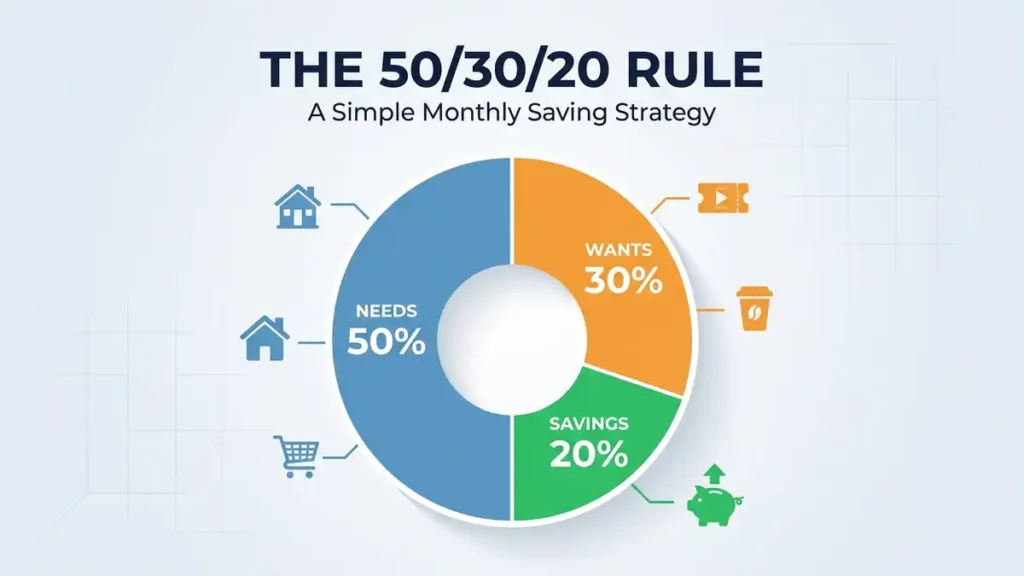
This remains the most widely recommended monthly saving strategy globally. You divide your after-tax income into three categories:
- 50% goes toward needs (rent, groceries, utilities, insurance)
- 30% goes toward wants (entertainment, dining out, hobbies)
- 20% goes toward savings and debt repayment
The strength of this method lies in its simplicity. You don’t need complicated spreadsheets or financial software. You just need three buckets and the discipline to respect the boundaries between them. I recommend this system to patients who feel overwhelmed by finance and need a starting point that doesn’t require a finance degree to understand.
2. Pay Yourself First
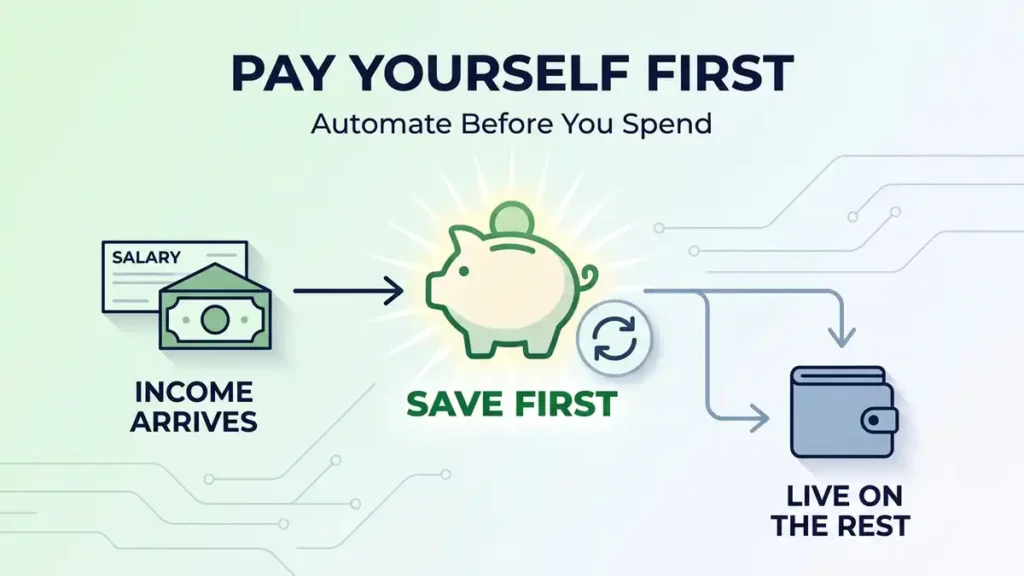
This strategy flips the traditional order of spending. Instead of saving whatever remains after expenses, you save a fixed percentage the moment your income arrives, then live on what’s left. Many financial educators consider this the single most powerful shift a person can make, because it removes the decision-making burden entirely. You never “decide” to save each month. The transfer happens automatically, often the same day your salary lands.
I find this method aligns beautifully with what we know about decision fatigue in medicine. Doctors who make hundreds of small decisions during a shift make worse choices by the end of it. The same happens with money. If you leave saving as a decision you make at the end of the month, after dozens of smaller spending decisions have already drained your mental energy, you will lose that battle almost every time. Automating the decision removes it from the equation completely.
3. The Envelope System
Popularized long before digital banking, the envelope system involves physically dividing cash into labeled envelopes for different spending categories: groceries, transport, entertainment, and so on. Once an envelope is empty, spending in that category stops until the following month.
Modern versions now use separate digital sub-accounts or dedicated saving apps that mimic this same psychological boundary. The core principle hasn’t changed: visible, physical limits reduce impulsive spending far more effectively than a single account with a vague mental budget attached to it.
4. Kakeibo, the Japanese Household Ledger Method

Kakeibo, which translates roughly to “household financial ledger,” is a Japanese saving philosophy that predates modern budgeting apps by more than a century. Unlike Western budgeting systems that focus purely on numbers, Kakeibo asks four reflective questions at the start of every month:
- How much money do I have?
- How much do I want to save?
- How much am I actually spending?
- How can I improve?
This method blends financial planning with mindfulness, encouraging savers to write things by hand and reflect on their spending emotions rather than just tracking numbers mechanically. Several personal finance researchers point to Kakeibo as one reason Japanese households historically maintain higher personal saving rates compared to many Western counterparts.
5. The 1% Incremental Increase Method
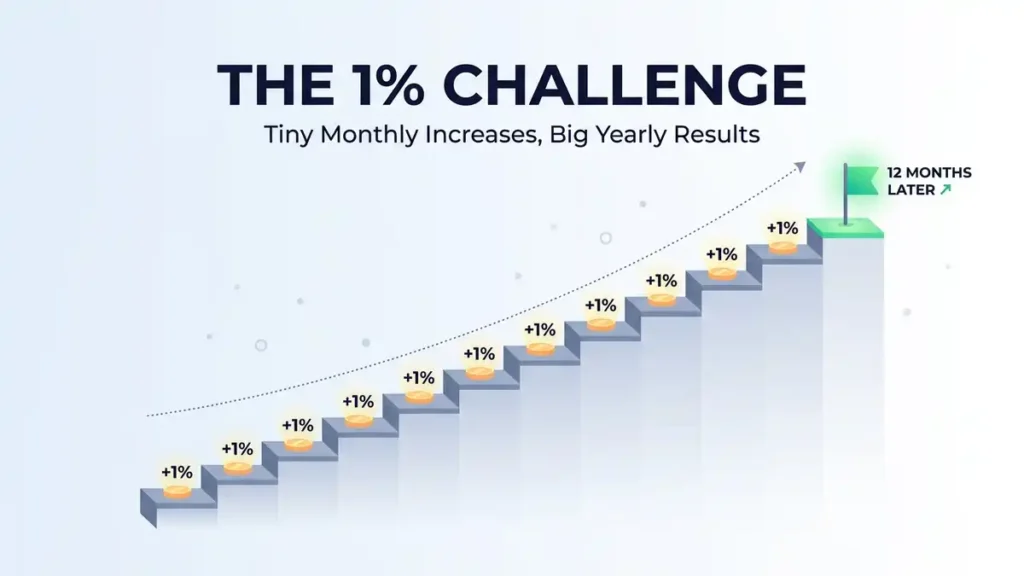
Rather than committing to a large saving percentage immediately, this strategy asks you to increase your savings rate by just 1% every month or every quarter. Because the change feels negligible in the moment, your brain doesn’t register it as a loss, and you avoid the psychological resistance that comes with dramatic, sudden cutbacks.
Over twelve months, a 1% monthly increase compounds into a meaningfully higher saving rate without ever feeling like deprivation. This aligns closely with behavioral research on loss aversion, the well-documented tendency for people to feel the pain of losing money roughly twice as intensely as the pleasure of gaining an equivalent amount.
What I Learned From a Patient Who Changed My View on Saving
Early in my career, I treated a patient in his mid-forties who came in with symptoms of chronic stress: disrupted sleep, elevated blood pressure, and persistent fatigue that no amount of rest seemed to fix. During the consultation, it became clear that his physical symptoms traced back almost entirely to financial anxiety. He earned a stable income, yet he had no savings buffer whatsoever. Every emergency, a car repair, a medical bill, a family obligation, sent him into a spiral of borrowing and repayment that never fully resolved.
We talked, and I asked him to describe his saving habits. He told me he “saved whatever was left” at the end of each month. Almost nothing was ever left. His financial stress wasn’t caused by low income. It was caused by the absence of a structured monthly saving strategy that didn’t depend on willpower.
I suggested he try automating a small, fixed transfer the day his salary arrived, even if the amount felt insignificant at first. Just enough to build a habit rather than a fortune. Months later, he returned for a routine follow-up and mentioned, almost as an afterthought, that his sleep had improved and his blood pressure readings looked better. He credited part of that shift to finally having a small cushion of savings that reduced his baseline anxiety.
This experience reinforced something I now repeat often: financial stress is a physiological stressor, not just an abstract worry. Chronic financial anxiety keeps cortisol elevated, disrupts sleep architecture, and contributes to the same inflammatory pathways associated with other forms of chronic stress. A consistent monthly saving strategy isn’t only a financial tool. It functions as a form of preventive medicine.
The Neuroscience Behind Successful Saving
Understanding why certain saving strategies succeed requires a basic understanding of how your brain processes reward and delay.
Your brain runs on two competing systems: the limbic system, which craves immediate reward, and the prefrontal cortex, which handles long-term planning and delayed gratification. Spending activates the limbic system almost instantly. Saving requires sustained prefrontal cortex engagement, which is metabolically expensive and easily overridden by stress, fatigue, or temptation.
This explains why automation consistently outperforms willpower-based approaches. When you automate your monthly saving strategy, you remove the need for your prefrontal cortex to win a daily battle against your limbic system. The decision happens once, during a calm, rational moment, rather than repeatedly during moments of temptation or stress.
Dopamine also plays a subtler role here. Research on habit formation shows that dopamine release shifts over time from the reward itself to the cue that predicts the reward. This means that once saving becomes a consistent monthly ritual, your brain eventually starts associating the act of saving, checking your growing account balance, watching a visual savings tracker fill up, with a small dopamine hit of its own. This is why gamified saving apps and visible progress bars work so well: they hijack the same reward circuitry that makes spending feel good, and redirect it toward saving instead.
A Step-by-Step Monthly Saving Strategy You Can Start This Week
Here is the practical system I recommend, combining the strongest elements of the strategies above with behavioral science principles.
Step 1: Calculate your true monthly income. Use your average net income over the last three months, not just your best month. This prevents overcommitting during leaner periods.
Step 2: Automate a fixed percentage transfer. Start with 10% if 20% feels unrealistic. Schedule the transfer for the same day your income arrives, before you see the money in your primary spending account.
Step 3: Separate your saving account physically. Use a different bank or a sub-account that isn’t linked to your everyday debit card. Friction reduces impulsive withdrawals.
Step 4: Apply the 50/30/20 framework to your remaining income. This keeps your needs and wants organized without requiring constant tracking.
Step 5: Increase your saving rate by 1% every quarter. Small, incremental increases avoid triggering the psychological resistance associated with sudden lifestyle cuts.
Step 6: Review your spending with a Kakeibo-style monthly reflection. Spend ten minutes at the end of each month asking what you saved, what you spent, and what you’ll adjust going forward. Written reflection strengthens the prefrontal cortex’s role in future decisions.
Step 7: Visualize your progress. Use a simple chart, app, or even a hand-drawn thermometer graphic tracking your saving goal. Visible progress reinforces the dopamine feedback loop discussed earlier.
This combined approach doesn’t ask you to master personal finance overnight. It asks you to build one automatic habit, then layer additional structure around it gradually.
Common Mistakes That Sabotage a Monthly Saving Strategy
Setting an unrealistic saving percentage from day one. Ambitious targets that ignore your actual spending patterns almost always collapse within two or three months.
Keeping savings in the same account as daily spending. Visibility without separation invites temptation. Your brain treats money it can see and access instantly as available for spending, regardless of your intentions.
Ignoring irregular expenses. Annual insurance premiums, car maintenance, or seasonal costs derail monthly budgets when they aren’t planned for in advance. Build a small buffer category specifically for these predictable but irregular costs.
Relying purely on motivation. Motivation fluctuates daily based on sleep, stress, and mood. Systems and automation remain consistent regardless of how you feel on a given day.
Never reviewing progress. Saving without reflection becomes mechanical and easy to abandon. Monthly check-ins, even brief ones, keep the habit psychologically reinforced.
Tools That Support a Strong Monthly Saving Strategy
Modern banking apps now offer round-up savings, where every purchase gets rounded to the nearest dollar and the difference moves automatically into savings. Others allow you to create multiple labeled sub-accounts that mimic the envelope system digitally. Whichever tool you choose, prioritize automation and visibility of progress over complexity of features. A saving system you actually use consistently will always outperform a sophisticated one you abandon after two weeks.
If you’re also managing performance-related stress, whether from trading, competitive work, or high-pressure careers, you may find it useful to explore how cortisol regulation affects trading psychology and how breathing techniques used by traders can reduce the impulsive decision-making that often derails both financial and physical health goals. Financial stress and physiological stress share more overlap than most people realize.
Frequently Asked Questions
What is the best monthly saving strategy for beginners? The Pay Yourself First method combined with automation offers the easiest entry point, since it removes the need for daily decision-making and builds consistency from the very first month.
How much of my income should I save each month? Financial researchers commonly recommend 20%, following the 50/30/20 rule, but starting with even 5–10% and increasing gradually produces more sustainable long-term results than an unrealistic target abandoned after a few weeks.
Why do I keep failing at saving money even with a budget? Most failures stem from relying on willpower rather than automation. A monthly saving strategy that requires constant conscious decisions will eventually lose to decision fatigue, regardless of how motivated you feel at the start.
Can financial stress actually affect physical health? Yes. Chronic financial anxiety keeps stress hormones elevated, which can disrupt sleep, elevate blood pressure, and contribute to broader inflammatory processes over time, a pattern I’ve observed repeatedly in clinical practice.
Final Thoughts
The best monthly saving strategy isn’t the most complicated one, and it isn’t the one your wealthiest friend swears by. It’s the one that survives contact with your actual life, your actual stress levels, and your actual brain chemistry. Automation beats willpower. Small, consistent increases beat dramatic overhauls. And visible progress beats invisible, forgotten goals.
Start small this month. Automate one transfer. Track it. Let your brain slowly learn that saving, not just spending, can produce its own quiet reward.
For more on the connection between brain chemistry, financial decision-making, and performance under pressure, explore related reading on nootropics and cognitive performance for traders and managing personal finances as a physician, both available on TheDopamineDoc.
External resources for further reading on structured budgeting frameworks include Investopedia’s guide to budgeting rules, NerdWallet’s saving strategy comparisons, and the American Psychological Association’s research on financial stress.
Medical Disclaimer
This article is written for general educational and informational purposes only and does not constitute financial or medical advice. While the physiological effects of stress described here are grounded in established medical literature, individual health circumstances vary. Readers experiencing persistent stress-related symptoms, whether financial in origin or otherwise, should consult a licensed physician or qualified financial advisor before making significant health or financial decisions. Dr. Nirosh does not establish a doctor-patient relationship through this content, and all patient scenarios described have been generalized to protect confidentiality.
About Us
TheDopamineDoc explores the intersection of neuroscience, behavior, and performance, translating medical and psychological research into practical strategies for everyday life. Written from the perspective of a practicing physician, the site covers topics ranging from trading psychology and cognitive performance to financial wellbeing and stress physiology, all grounded in evidence-based science and real clinical experience.