
The 1-3-6 Savings Rule is a simple money framework that tells you exactly how much to save at three checkpoints: one month, three months, and six months. Instead of tracking dozens of budget categories, you follow one clear number at each stage of your financial year. As a physician interested in dopamine, motivation, and behavioral science, I built this framework because most people don’t fail at saving money due to a lack of discipline — they fail because their saving system asks their brain to do too much at once.
This article breaks down exactly how the 1-3-6 Savings Rule works, why it aligns with how your brain actually processes reward and effort, and how to apply it step by step, whether you’re a salaried employee, a business owner, or a physician managing irregular income like I do.
What Is the 1-3-6 Savings Rule?

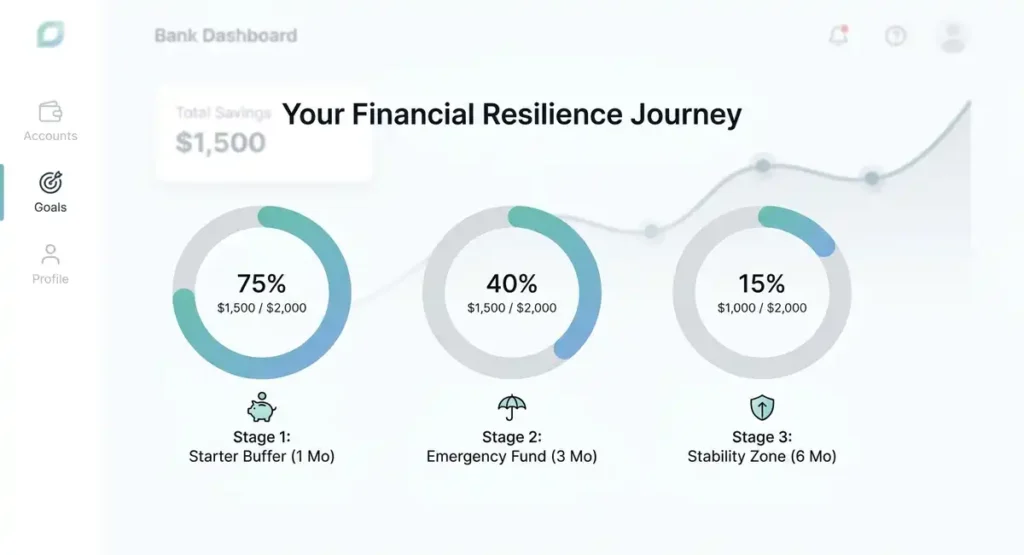
The 1-3-6 Savings Rule is a three-stage savings framework built around one guiding idea: shrink the goal so your brain doesn’t reject it. Each number represents a milestone measured in months of your essential living expenses.
- 1 — Save one month of essential expenses first. This is your starter buffer.
- 3 — Grow that buffer to three months of expenses. This becomes your real emergency fund.
- 6 — Extend the buffer to six months of expenses. This is your stability zone, the point where a job loss, medical event, or income gap no longer threatens your household.
Unlike percentage-based rules that ask you to save a fixed slice of income every month regardless of your situation, the 1-3-6 Savings Rule is milestone-based. You are not chasing a monthly percentage forever; you are climbing toward three concrete finish lines, one at a time.
Why Traditional Budgeting Fails (and How 1-3-6 Fixes It)
Most budgeting advice assumes people are rational actors who simply need better spreadsheets. In practice, behavioral finance research shows something different: humans are wired for short-term reward, and abstract, distant goals like “retirement” or “financial freedom” don’t activate the brain’s reward circuitry the way an immediate purchase does.
This is where the 1-3-6 Savings Rule works differently. Instead of one enormous, abstract target — “save six months of expenses” — it gives you a small, achievable first win. Hitting the “1” milestone takes weeks, not years, for most working adults. That early success triggers a dopamine response tied to progress and completion, which makes it easier to stay motivated for the “3” and “6” stages that follow. You can read more about how this reward loop drives financial behavior in our article on the psychology behind revenge trading, where the same dopamine mechanics work against savers instead of for them.
Breaking Down the 1-3-6 Savings Rule: Step by Step
Step One: The “1” — One Month of Expenses First
Start by calculating your essential monthly expenses: rent or mortgage, utilities, groceries, transport, insurance, and loan repayments. Exclude discretionary spending like dining out or entertainment. Your first target under the 1-3-6 Savings Rule is to save exactly that number.
For most households, this milestone is reachable within one to three months if 10–15% of income is redirected toward it. Keep this money in a separate savings account so it is visible but not mixed with your daily spending account.
Step Two: The “3” — Three Months of Runway
Once your one-month buffer is in place, the second stage of the 1-3-6 Savings Rule is to triple it. Three months of expenses covers the most common financial shocks: a short period of unemployment, an unexpected medical bill, or a temporary drop in business income. This is the stage most financial planners consider the minimum viable emergency fund.
At this point, consider placing the fund in a fixed deposit or a high-interest savings account rather than a current account, so the money earns a modest return while remaining accessible within a few days.
Step Three: The “6” — Six Months of Stability
The final stage of the 1-3-6 Savings Rule extends your buffer to six full months of essential expenses. A six-month emergency fund can provide substantially more protection against income disruption. Physicians, business owners, freelancers, and anyone with variable income should treat this as a firm target rather than an optional stretch goal, since irregular income makes the one-month and three-month stages less reliable protection on their own.
Once you reach six months, any additional saving can be redirected toward investing, which is a separate goal from emergency protection and deserves its own framework.
The Psychology Behind the 1-3-6 Savings Rule
The reason the 1-3-6 Savings Rule works better for many people than a flat “save 20% of income” instruction comes down to goal gradient theory: motivation increases as a person gets closer to a defined finish line. A single, undivided goal that sits years away produces the opposite effect, since the distance to completion never seems to shrink in any meaningful way.
By splitting the process into three checkpoints, the 1-3-6 Savings Rule creates three separate finish lines instead of one. Each time you cross one, your brain registers a completed goal rather than a fraction of an unfinished one. This is the same principle discussed in our piece on the SpaceX mindset for iterative goal-setting, where breaking a large target into testable stages improves both follow-through and resilience after setbacks.
How to Apply the 1-3-6 Savings Rule
The 1-3-6 Savings Rule can be adapted to local banking tools without much friction. A practical approach looks like this:
- Open a separate savings account at your existing bank purely for this fund, so it stays out of sight from everyday spending.
- Use standing order instructions to auto-transfer a fixed amount on payday, before you have the chance to spend it.
- Once you clear the “3” milestone, consider moving part of the fund into a short-term fixed deposit for a better return while keeping it liquid.
- Track your progress against local inflation, since essential expenses in living costs can change significantly over time can shift meaningfully year to year, which changes your target number under the 1-3-6 Savings Rule.
If you are also building a longer-term investment plan alongside your emergency fund, our earlier breakdown of the <a href=”https://thedopaminedoc.com/1-3-6-monthly-saving-strategy/”>1-3-6 monthly saving strategy for salaried professionals</a> covers how to layer investment contributions on top of this framework once your buffer is complete.
Common Mistakes When Following the 1-3-6 Savings Rule
Even a simple system can be applied poorly. These are the most frequent errors:
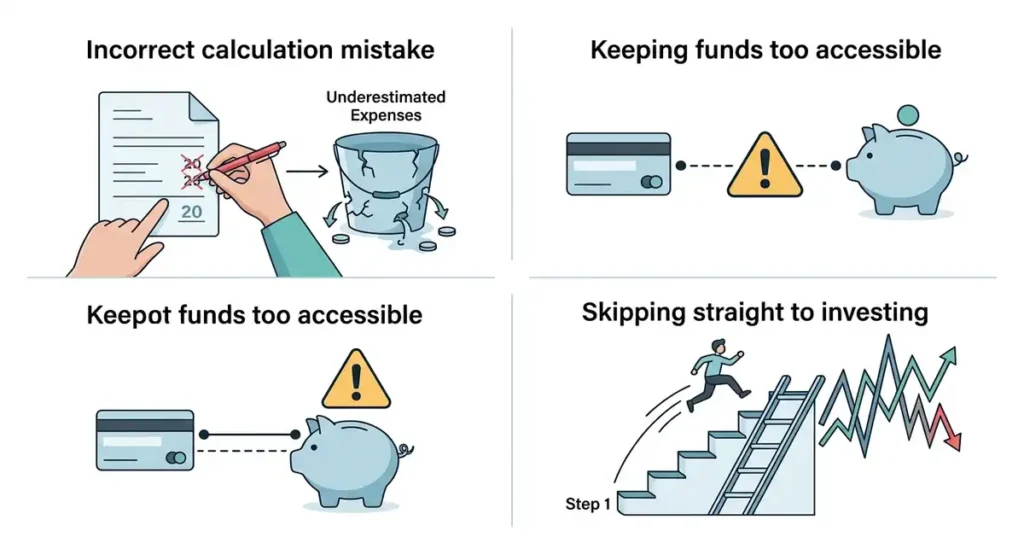
- Calculating expenses incorrectly. Many people underestimate their true monthly essential spending, which makes each stage of the 1-3-6 Savings Rule smaller than it should be.
- Keeping the fund too accessible. A savings account linked to a debit card you use daily invites withdrawals for non-emergencies.
- Skipping straight to investing. Some savers move to the stock market or unit trusts before completing the “3” or “6” stage, leaving themselves exposed if the market dips at the same time as an income shock.
- Treating the target as fixed forever. Your expenses change as your life changes. Recalculate your 1-3-6 Savings Rule targets at least once a year.
- Abandoning the plan after a withdrawal. Life happens. If you dip into the fund, the correct response is to restart the current stage, not abandon the system entirely.
1-3-6 Savings Rule vs Other Saving Methods
| Method | Structure | Best For | Main Drawback |
|---|---|---|---|
| 1-3-6 Savings Rule | Three milestone targets (1, 3, 6 months of expenses) | People who need visible, short-term wins to stay motivated | Requires recalculating expenses periodically |
| 50/30/20 Rule | Fixed percentage split of income | People with stable, predictable income | Doesn’t adjust for irregular income |
| Pay Yourself First | Fixed amount saved before spending | Beginners building a habit | No clear finish line or milestone |
| Zero-Based Budgeting | Every rupee assigned a job monthly | Detail-oriented planners | Time-consuming to maintain |
A Sample Six-Month Action Plan
- Month 1–2: Calculate essential expenses. Automate transfers toward the “1” milestone.
- Month 3: Confirm the one-month buffer is complete. Begin building toward “3.”
- Month 4–5: Continue automated transfers. Move completed funds into a higher-interest account.
- Month 6: Reach the three-month milestone. Reassess income stability before pushing toward six months.
- Month 7 onward: Continue saving toward the six-month target at a pace matched to your income type — faster for variable earners, steadier for salaried employees.
Frequently Asked Questions About the 1-3-6 Savings Rule
Is the 1-3-6 Savings Rule suitable for people with irregular income? Yes. In fact, the milestone structure of the 1-3-6 Savings Rule tends to suit variable earners better than flat-percentage rules, since you can save more aggressively during high-income months and slow down during lean ones without losing track of your target.
How long does it take to complete the 1-3-6 Savings Rule? Most people reach the full six-month milestone within one to two years, depending on income, expenses, and how much of each paycheck they redirect toward saving.
Should I invest while working through the 1-3-6 Savings Rule? Small, low-risk contributions are fine, but the priority should stay on completing each milestone before shifting meaningful money into higher-risk investments.
A Real-World Example of the 1-3-6 Savings Rule in Action
Consider a young professional in Colombo earning a stable monthly salary, with essential expenses of Rs. 80,000 covering rent, utilities, transport, and groceries. Under the 1-3-6 Savings Rule, her first target is Rs. 80,000 — one month of expenses. By automating a transfer of Rs. 20,000 per month into a separate account, she reaches this milestone in four months.
Her second target under the 1-3-6 Savings Rule is Rs. 240,000, or three months of expenses. Because she has already built the saving habit during stage one, this stage feels less demanding even though the number is three times larger. She reaches it roughly eight months later by keeping the same automated transfer in place and adding a portion of her annual bonus.
Her final target is Rs. 480,000, six months of expenses. At this stage, she splits new contributions between the emergency fund and a modest unit trust investment, since her buffer already covers the most likely disruptions to her income. This staged approach is the core advantage of the 1-3-6 Savings Rule over a single, distant savings goal: each stage builds confidence and momentum for the next.
Tools That Make the 1-3-6 Savings Rule Easier to Follow
You do not need complex software to run the 1-3-6 Savings Rule successfully. A few simple tools are enough:
- A dedicated savings account. Separating this fund from your everyday spending account is the single most effective step, since it removes the fund from your mental “available balance.”
- Standing orders or auto-debit instructions. Automating the transfer removes the need for willpower on payday, which is often the point where saving plans break down.
- A simple tracking sheet or app. A basic spreadsheet with three rows — one for each milestone of the 1-3-6 Savings Rule — is enough to visualize progress without adding complexity.
- A calendar reminder to recalculate expenses. Essential costs shift over time, so revisiting your numbers every six to twelve months keeps each milestone of the 1-3-6 Savings Rule accurate.
Who Should Use the 1-3-6 Savings Rule
The 1-3-6 Savings Rule is flexible enough to suit several different financial situations, though the pace at which each stage is completed will vary:
- Salaried employees with predictable income can automate fixed monthly transfers and expect to move through all three stages in a fairly linear timeline.
- Physicians, freelancers, and business owners with variable income can use higher-earning months to accelerate progress and slow down without guilt during leaner months, since the milestones — not a fixed monthly percentage — define success under the 1-3-6 Savings Rule.
- Young professionals early in their careers benefit from the visible, achievable first milestone, which builds the saving habit before larger financial responsibilities like a mortgage or family expenses arrive.
- Households recovering from debt can apply the 1-3-6 Savings Rule after high-interest debt is cleared, since an emergency fund without an underlying debt problem prevents the same debt cycle from repeating.
Conclusion
The 1-3-6 Savings Rule works because it respects how your brain actually processes goals: in small, visible stages rather than one distant, abstract target. Whether you are a salaried professional in Colombo or a physician managing irregular clinic income like I do, the same three checkpoints apply. Start with one month, protect yourself with three, and build lasting stability with six.
Disclaimer: This article is for general educational and informational purposes only and does not constitute personalized financial or medical advice. Consult a licensed financial advisor before making significant changes to your savings or investment strategy.
Written by Dr. Nirosh Physician | Behavioral Medicine & Performance Psychology Writer, thedopaminedoc.com