FOMO trading psychology explains a pattern almost every trader recognizes: you watch an asset rip higher on your screen, you feel a tightening pressure in your chest, and you buy — not because your setup confirmed anything, but because you cannot stand to watch the candle climb without you in it. Within hours, the move stalls, price reverses, and you sell at a loss you didn’t plan for. This isn’t a character flaw. It’s a predictable output of a brain circuit that evolved long before candlestick charts existed, and understanding that circuit is the first step to controlling it.
What Is FOMO Trading Psychology?
FOMO trading psychology refers to the decision-making pattern that pushes traders to enter positions late, chasing price after a move has already happened, driven by the fear of missing further gains rather than by an actual edge. It shows up as impulsive entries near local tops, oversized position sizes taken “just this once,” and a tendency to abandon a trading plan the moment a watchlist asset starts pumping without you in it.
Retail traders often describe FOMO as a moment of weak discipline. Neuroscience tells a different story. The urge to chase a green candle doesn’t originate in the prefrontal cortex, the part of your brain responsible for weighing risk and reward rationally. It originates deeper, in a region built for a much older job: predicting reward before it arrives.
The Neuroscience Behind FOMO Trading Psychology: Your Brain on Green Candles
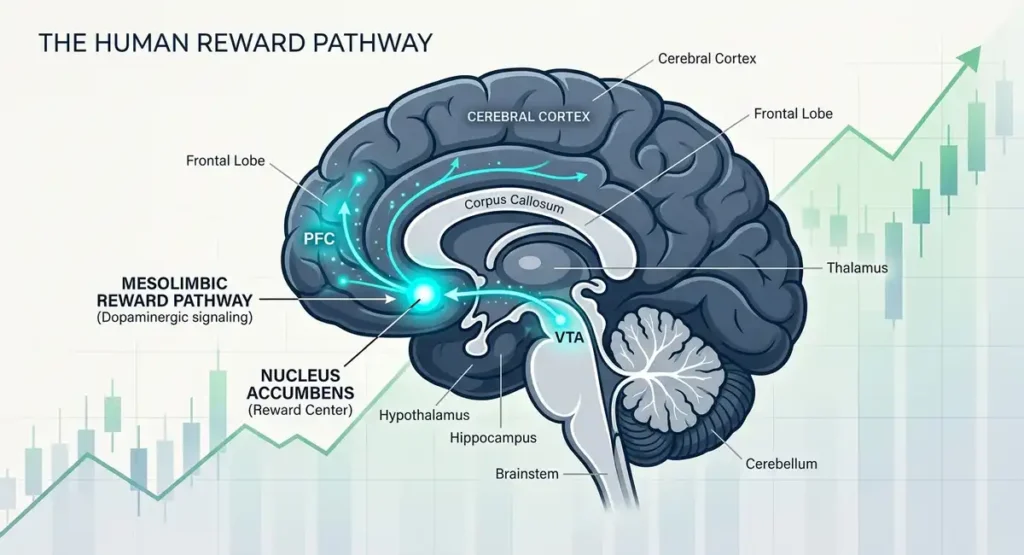
To understand FOMO trading psychology, you need to understand one small structure sitting near the base of your brain: the nucleus accumbens, part of the mesolimbic dopamine pathway. This structure doesn’t just respond to rewards. It responds to the anticipation of rewards, and that distinction changes everything about how trading FOMO actually works.
Dopamine Doesn’t Reward Winning — It Fires Before You Win
Research on reward prediction popularized by neuroscientist Wolfram Schultz found that dopamine neurons spike most sharply not at the moment of reward, but in the gap between a cue and an uncertain, possibly larger payoff. A rising chart is exactly that kind of cue. Each green candle functions as a signal that a reward might be coming, and your nucleus accumbens fires on that possibility long before you’ve clicked buy. By the time you consciously “decide” to enter the trade, the dopamine surge has already been running for several minutes, and your prefrontal cortex is doing damage control rather than genuine analysis.
Why Pumping Assets Hijack the Reward Circuit So Effectively
Three features of a pumping asset make it almost custom-built to trigger this circuit:
- Uncertainty of outcome. You don’t know if it keeps climbing, which maximizes dopamine firing compared to a predictable, steady gain.
- Social proof and visible activity. Rising volume, trending hashtags, and a crowded comment section signal that other people are already winning, and social reward circuits overlap heavily with the dopamine pathway.
- Compressed time pressure. A fast-moving candle removes the normal window for deliberation, so the anticipatory dopamine response reaches your motor decision to click buy before slower, rational circuits catch up.
None of this means you’re undisciplined. It means your brain is responding exactly as a mesolimbic dopamine system is supposed to respond to an ambiguous, socially-reinforced, time-pressured reward cue. FOMO trading psychology is a wiring problem before it’s a willpower problem.
FOMO Trading Psychology Isn’t a Willpower Failure — It’s a Prediction Error
Here’s the part most trading psychology content skips: the pain that follows a bad FOMO entry isn’t just financial. When price reverses after you chase it, your brain registers a negative prediction error — the anticipated reward didn’t arrive, and dopamine activity drops sharply below baseline. That crash in dopamine is what produces the specific, gutted feeling of “I knew better” regret. Traders often respond to that dip by seeking the next anticipatory spike immediately, which is one mechanism behind the FOMO-into-revenge-trading spiral. If you’ve read our breakdown of revenge trading psychology, you’ve already seen the second half of this same neural loop.
The FOMO Trading Psychology Cycle: From Scroll to Regret
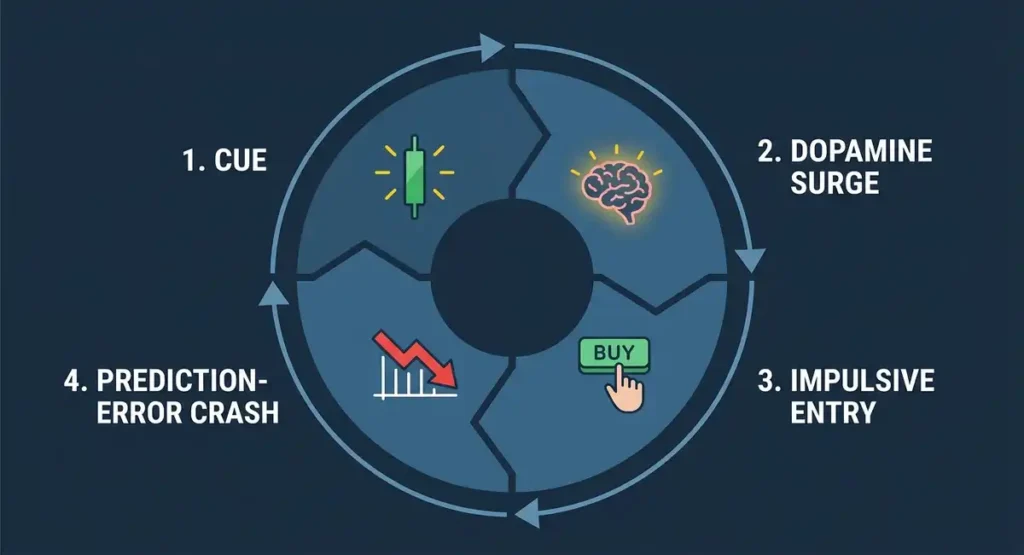
The cycle tends to repeat in four predictable stages:
- Cue exposure. You see a chart, an alert, or a group chat screenshot showing an asset pumping.
- Anticipatory dopamine surge. The nucleus accumbens fires based on uncertainty and social proof, before any analysis happens.
- Impulsive entry. You buy late, often at a size larger than your plan allows, because the urgency feels like conviction.
- Prediction error and crash. Price stalls or reverses, dopamine drops below baseline, and you feel the specific regret that fuels the next impulsive trade.
Recognizing which stage you’re in, in real time, is more useful than trying to will yourself into discipline after the fact.
4 Steps to Interrupt FOMO Trading Psychology
You cannot switch off the nucleus accumbens. You can, however, build friction into the moments where it tries to make decisions for you.
Step 1: Name the Cue Before You Act
The instant you notice a chart pulling your attention, say out loud or type into a notes app: “This is a dopamine cue, not a signal.” Labeling the physiological state — a technique supported by affect-labeling research in cognitive neuroscience — reduces amygdala reactivity and gives your prefrontal cortex a few extra seconds to engage.
Step 2: Apply a Mandatory Delay
Set a hard rule: no entry within 15 minutes of first noticing a pump. Anticipatory dopamine spikes are short-lived by design. A structured delay lets the surge pass before your motor decision to click buy, which is often enough on its own to prevent a FOMO trading psychology mistake.
Step 3: Pre-Commit to Position Sizing in Writing
Decide your maximum position size for chase trades before you’re in an emotional state, and write it somewhere you have to actively override to ignore. Traders who use written pre-commitment rules show far lower deviation from their trading plan than those relying on in-the-moment willpower, echoing findings from behavioral economics on commitment devices.
Step 4: Replace the Cue With a Process Reward
Because your brain is chasing anticipation, give it something to anticipate that isn’t the trade itself. Track your rule-following streak — days you avoided a FOMO entry — the same way you’d track a trading P&L. This redirects the dopamine anticipation circuit toward process discipline instead of price action, which is also the underlying logic behind the <a href=”https://thedopaminedoc.com/1-3-6-savings-rule”>1-3-6 Savings Rule</a> we’ve written about for personal finance habits: small, trackable wins retrain the reward loop over time.
When FOMO Trading Psychology Becomes a Pattern Worth Addressing Directly
Occasional FOMO trades happen to nearly every active trader. A pattern is different: if chasing pumps is costing you a consistent percentage of your account monthly, disrupting sleep, or driving you to hide trades from a partner or track them compulsively, that’s no longer just a trading psychology issue — it edges toward behavior that overlaps with compulsive reward-seeking more broadly. In that case, a conversation with a physician or licensed mental health professional experienced in behavioral addiction is a reasonable next step, alongside any trading-specific coaching.
Turning Neuroscience Into a Trading Edge
FOMO trading psychology sits at the intersection of ancient reward circuitry and modern, fast-moving markets. The nucleus accumbens doesn’t know the difference between a ripe fruit tree and a green candle — it only knows uncertainty, social proof, and time pressure predict reward, and it fires accordingly. Once you see the chase for what it is — a prediction error waiting to happen, not a moral failing — you can build the structural delays and pre-commitments that work with your brain’s wiring instead of fighting it every single trade.
If you want the finance-focused half of this same dopamine framework, see our piece on <a href=”https://thedopaminedoc.com/monthly-saving-strategies”>monthly saving strategies</a> and how the same anticipation circuit that drives FOMO trades can be redirected toward long-term saving behavior.
Medical Disclaimer: This article is for educational and informational purposes only and does not constitute medical, psychological, or financial advice. It is not a substitute for professional diagnosis or treatment. If you are experiencing compulsive trading behavior, financial distress, or symptoms of anxiety or addiction, please consult a licensed physician or mental health professional.
Written by Dr. Nirosh, physician and founder of thedopaminedoc.com, exploring the neuroscience of behavior, money, and performance.