
By Dr. Nirosh, MBBS · Reading time: about 7 minutes
Most people know they should have an emergency fund. Far fewer actually build one. That gap is not about discipline or intelligence. It is about how the brain is wired to weigh rewards, and understanding emergency fund psychology is the fastest way to close it.
In this guide you will learn how much to save, why your brain resists saving for a problem that has not happened yet, and how to set the whole thing up so that willpower is barely involved.
How Much Should an Emergency Fund Be?
The standard guidance is to hold three to six months of essential expenses in cash that you can reach quickly. The key word is essential. Count rent or mortgage, utilities, food, transport, insurance, minimum debt payments and any dependants’ costs. Do not count holidays, subscriptions or trading losses.
A useful way to adjust that range:
- Three months if your income is stable, you have no dependants and you have other safety nets such as family support or good insurance.
- Six months if you are the main earner, have a mortgage or have children.
- Nine to twelve months if your income is variable. That includes freelancers, business owners, commission-based workers and anyone whose income depends on trading performance.
If six months of expenses feels impossible today, that is normal. Start with one month. A small buffer already changes how you respond to a flat tyre, a medical bill or a delayed salary, and it is the first step in the ladder described in our 1-3-6 Savings Rule guide.
Why Your Brain Resists Saving for Emergencies
An emergency fund asks your brain to do something it is poor at: pay a certain cost now to protect against an uncertain problem later. Four mechanisms work against you.
1. Present bias: the future feels like someone else

Behavioural economists describe present bias (also called hyperbolic discounting): we value rewards today far more than rewards of equal size in the future. Research on this, including David Laibson’s work on hyperbolic discounting, helps explain why “I’ll start saving next month” feels reasonable every single month.
Neuroimaging studies on delay discounting suggest that decisions favouring immediate rewards engage the brain’s reward circuitry more strongly, while patient choices lean more on prefrontal regions involved in planning. Put simply, spending now speaks louder than saving for later.
2. The dopamine mismatch

Dopamine is often called the pleasure chemical, but it is better described as a prediction and motivation signal. It rises when we anticipate a reward, such as a new purchase, a delivery notification or a winning trade.
An emergency fund offers almost none of that. Nothing arrives, nothing changes, and the best possible outcome is that nothing bad happens. A boring, invisible reward cannot compete with a vivid, immediate one. That is why savings accounts rarely feel exciting and spending nearly always does.
3. Loss aversion and the “dead money” feeling
In prospect theory, Kahneman and Tversky showed that losses feel roughly twice as painful as equivalent gains feel good. Money sitting in an emergency fund can feel like a loss of opportunity: “This could be invested, this could be earning more.”
That feeling is what pushes people to raid the fund for a good-looking opportunity. Reframe it. The fund is not idle capital. It is insurance, and its return is not being forced to sell investments, borrow or panic when life interrupts.
4. Optimism bias: “It won’t happen to me”
Most people underestimate their own risk of job loss, illness or unexpected costs. Optimism bias is useful in many areas of life, but it makes the abstract risk of an emergency feel unreal until it arrives.
How Stress Makes the Problem Worse
There is also a feedback loop. Financial pressure raises stress, and chronic stress affects the same prefrontal regions you need for planning. Researchers Sendhil Mullainathan and Eldar Shafir describe this in their work on scarcity: when money is tight, mental bandwidth narrows and short-term thinking takes over.
Stress hormones such as cortisol can also push the brain toward quick, habit-driven choices. If you want to understand how this plays out in markets, read our article on cortisol and trading.
The practical lesson is that an emergency fund is not only a financial tool. It lowers background stress, which protects the very part of your brain that makes good decisions.
How to Build an Emergency Fund With Your Brain, Not Against It
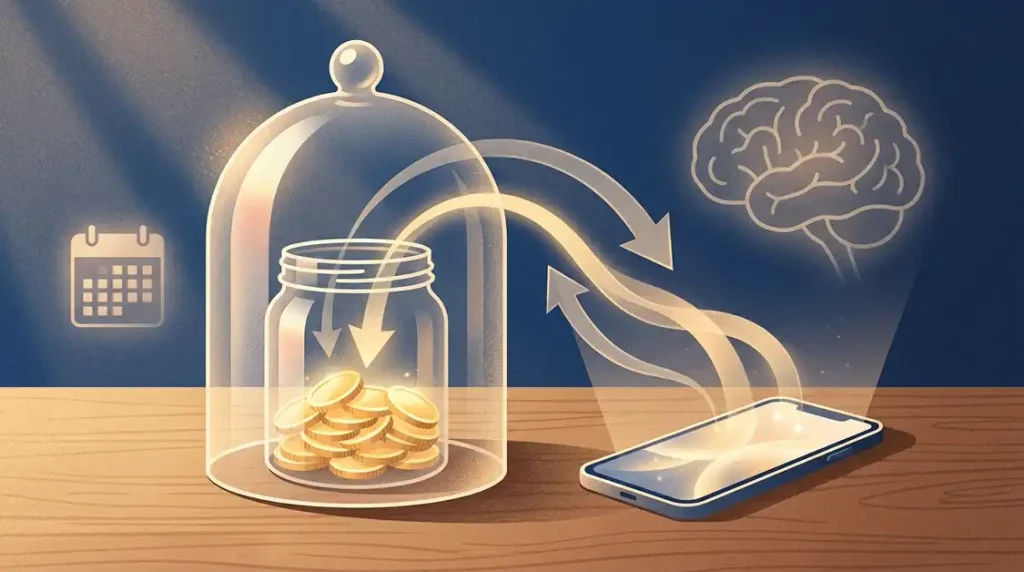
The best strategy is one that does not rely on motivation. These steps work with the biases described above.
Step 1: Automate it
Set up an automatic transfer on payday, before you see the money. This sidesteps present bias, because there is no decision to make and nothing to feel deprived of. Our guide to monthly saving strategies shows several ways to structure this.
Step 2: Start with a small, visible target
A vague goal such as “save six months” gives the brain no reward signal. Break it into milestones: one week of expenses, one month, then three. Each milestone gives a small, real sense of progress, which is exactly what the dopamine system responds to.
Step 3: Make it a separate account
This uses mental accounting to your advantage. Money in a clearly labelled account called “Emergency Fund” is psychologically harder to spend than money mixed into your main account. Keep it somewhere accessible but not too convenient, such as a separate savings account without a debit card.
Step 4: Write down what counts as an emergency
Decide in advance, when you are calm, what qualifies. A job loss, a medical bill or an urgent home repair counts. A sale, a holiday or a “can’t-miss” trade does not. Pre-commitment protects you from your future self.
Step 5: Track progress with a tool that makes it visible
Seeing the balance grow is a reward in itself. Our review of the best personal finance apps in 2026 explains which apps are built around behaviour rather than just features.
Special Cases: Traders, Freelancers and Doctors
If you trade: never treat your emergency fund as trading capital. When a drawdown hits and you feel the urge to “win it back,” a fund you can touch becomes a risk. Keep it in a separate account and treat it as untouchable. This is one of the simplest protections against the cycle described in our revenge trading guide.
If your income is irregular: aim for the upper end of the range and base your target on your lowest-earning months, not your best.
If you are a doctor: a high income does not remove the need. Long training years, student debt, shift patterns and burnout risk mean a gap in work can arrive suddenly. Our article on how doctors can build wealth covers why the usual advice needs adjusting for a medical career.
A Simple Starter Plan
- Calculate your essential monthly expenses.
- Multiply by three to find your first big target.
- Open a separate account and automate a transfer on payday, even a small one.
- Set milestones at one week, one month and three months.
- Write down your “what counts as an emergency” rule.
- Review once a quarter and increase the transfer when your income rises.
Frequently Asked Questions
Where should I keep my emergency fund?
Somewhere safe, liquid and separate from your spending money, such as a savings account or similar low-risk, easily accessible option. Availability matters more than return.
Should I pay off debt or build an emergency fund first?
Many people build a small starter buffer first, then work on high-interest debt. Without any buffer, an unexpected cost can push you straight back into borrowing. The right balance depends on your own circumstances, so consider speaking to a qualified financial adviser.
Is it okay to invest my emergency fund?
Generally no. The purpose of the fund is stability and quick access, and market values can fall exactly when you need the money.
Final Thoughts
Your brain is not broken when it resists saving for an emergency. It is doing what it evolved to do: prioritise the present, chase vivid rewards and underestimate rare risks. The solution is to build systems that account for this: automation, small milestones, separate accounts and rules set in advance.
Start small, make it automatic and let the fund quietly lower your stress while it grows.
About the author: Dr. Nirosh is an MBBS-qualified physician registered with the Sri Lanka Medical Council. He writes about the neuroscience of focus, trading psychology and money habits.
Medical & investment disclaimer: The information on The Dopamine Doc is published for educational purposes only. It is not medical advice, diagnosis or treatment, and reading it does not create a doctor-patient relationship. Articles about trading, saving or investing are commentary on behaviour and psychology. They are not financial advice and not a recommendation to buy or sell any asset. Capital is at risk in all markets. Read the full disclaimer.