
By Dr. Gihan Nirosh, MBBS
Imagine you find $100 on the street. You smile, maybe buy lunch, and forget about it by evening. Now imagine you lose $100 from your wallet. You retrace your steps, replay the moment, and feel irritated for days.
The amount is the same, but the feeling is not. This gap has a name: loss aversion. It is one of the most powerful forces in human decision-making, and it quietly controls how you invest, trade, save, and spend.
As a doctor, I find loss aversion fascinating because it does not start in your wallet. It starts in your brain. In this article, I explain the neuroscience behind it, show how it drains trading accounts, and give you seven practical ways to take back control.
What Is Loss Aversion?
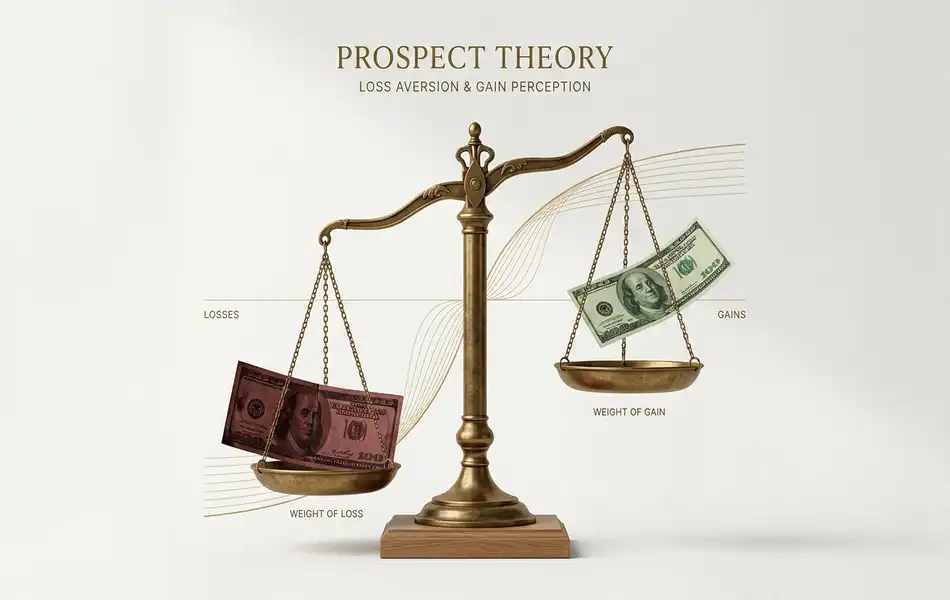
Loss aversion describes a simple pattern: losses feel stronger than equal gains. Psychologists Daniel Kahneman and Amos Tversky introduced the idea in their landmark 1979 paper on prospect theory, which later helped Kahneman win the Nobel Prize in Economics.
Their research showed that people do not judge outcomes in absolute terms. Instead, they judge them as gains or losses relative to a reference point, usually what they already have. Losses hit harder.
How much harder? Most studies estimate that a loss feels roughly twice as intense as a gain of the same size. A 2024 meta-analysis in the Journal of Economic Literature pooled hundreds of estimates and found that the typical loss aversion ratio sits close to 2. The exact number varies from person to person and situation to situation, but the pattern holds across cultures, ages, and income levels.
The $100 Coin Flip Test
Try this quick experiment on yourself.
I offer you a coin flip. Heads, you win $100. Tails, you lose $100. Do you take the bet?
Most people say no. Mathematically, the bet is fair, since your expected value is zero. Yet your brain rejects it because the potential loss looms larger than the potential win.
Now I change the offer: heads, you win $200; tails, you lose $100. Many people still hesitate. Most only accept when the win reaches around $200 to $250. That gap between fair odds and the odds you demand is loss aversion in action.
The Neuroscience of Loss Aversion: Your Brain’s Alarm System
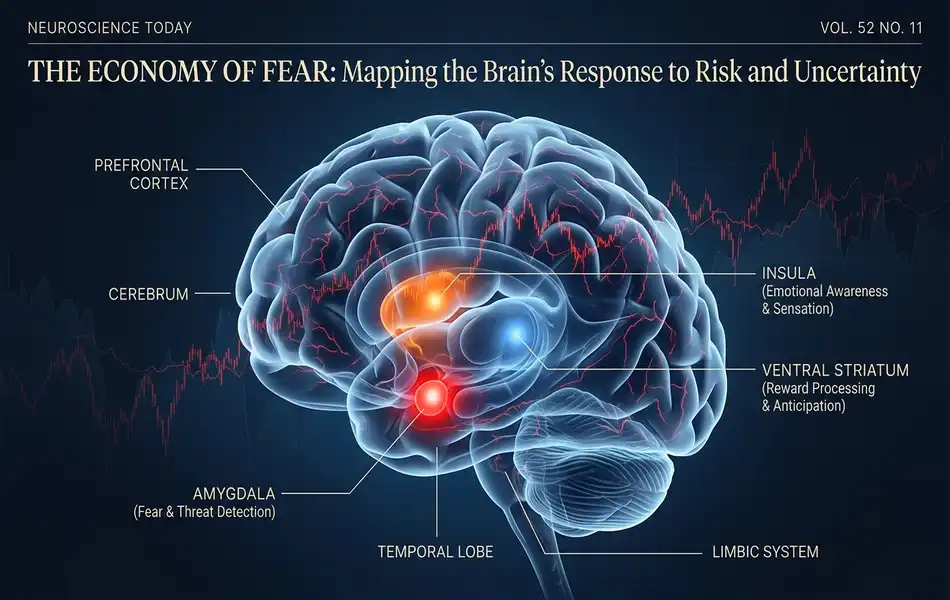
Loss aversion is not a character flaw. Several brain regions work together to produce it. Here are the three key players.
The Amygdala: Your Threat Detector
The amygdala is a small, almond-shaped structure deep in your temporal lobe. It scans your environment for threats and triggers fear responses. When you face a potential loss, the amygdala sounds the alarm.
The strongest evidence comes from a rare group of patients. In a 2010 study published in PNAS, researchers tested two people with focal damage to both amygdalae. These patients showed no loss aversion at all. They accepted gambles that healthy volunteers rejected. Without a working amygdala, a $100 loss no longer felt bigger than a $100 gain.
This finding tells us something important: the amygdala does not just react to losses. It actively weights them, making them feel heavier in your decisions.
The Insula: Your Body’s “Something Feels Wrong” Signal
The insula, folded deep inside the cerebral cortex, reads your internal body state. It registers disgust, pain, and that uneasy gut feeling you get before a bad decision.
In a well-known study of financial risk-taking, Stanford researchers scanned participants while they chose between safe and risky investments. Activity in the anterior insula rose before people made overly cautious choices. When the insula fired, people played it too safe, even when the risky option was the smarter move.
For traders, this matters. That knot in your stomach before you enter a trade is your insula at work. Sometimes it protects you. Often it simply makes you freeze.
The Striatum: Where Value Gets Calculated
Your ventral striatum, part of the brain’s reward system, calculates how valuable an option looks. It is rich in dopamine signaling.
A 2007 study in Science found that potential gains increased activity in the striatum, while potential losses decreased it. The drop for losses was steeper than the rise for gains. The researchers called this “neural loss aversion.” Participants whose brains showed a larger asymmetry also behaved in more loss-averse ways.
In other words, your reward system does not just enjoy gains. It actively punishes losses, and it punishes them harder.
Why Evolution Built a Brain That Fears Losses
Why would your brain work this way? A leading explanation comes from evolution.
For our ancestors, losing food, shelter, or safety could mean death. Gaining a little extra food rarely changed survival odds much. A brain that treated losses as emergencies had a better chance of passing on its genes.
That logic served humans well for thousands of years. It serves you poorly in a stock market, where small, controlled losses are a normal cost of doing business. Your brain still treats a red number on a screen like a predator in the grass.
How Loss Aversion Destroys Trading Accounts

Loss aversion does its most expensive damage in trading. Here is how it shows up.
1. You Hold Losing Trades Too Long
Closing a losing trade makes the loss real, and your brain hates that. So you hold on and hope the price comes back. Finance researchers call this the disposition effect.
Economist Terrance Odean analyzed thousands of brokerage accounts in a classic 1998 study. He found that investors sold winning stocks far more readily than losing ones. Worse, the winners they sold went on to outperform the losers they kept. Loss aversion cost them money twice.
2. You Cut Winners Too Early
The flip side stings just as much. When a trade moves into profit, your brain fears watching that gain disappear. You grab a small win early and miss the bigger move.
The result is a toxic pattern: small wins, big losses. Even a high win rate cannot save an account that runs this way.
3. You Chase Losses With Revenge Trades
After a painful loss, your brain wants to erase it fast. You double your position size, skip your rules, and jump into a low-quality setup. I cover this spiral in detail in my guide to revenge trading psychology. Loss aversion lights the fuse, and emotional arousal does the rest.
4. You Fear Missing Out, Which Is Loss Aversion in Disguise
Watching others profit from a move you skipped feels like a loss, even though you lost nothing. Your brain frames the missed gain as a loss against your imagined reference point. That feeling drives impulsive entries, as I explain in my article on FOMO trading.
5. Stress Makes Loss Aversion Worse
Stress hormones amplify this bias. A PNAS study of cortisol and risk-taking found that raising cortisol levels over several days made participants significantly more risk averse. During a volatile market, rising cortisol can push you into panic selling at the worst possible moment. Read more in my breakdown of cortisol and trading.
Loss Aversion in Everyday Money Decisions
You do not need to trade to feel loss aversion’s pull. It shapes daily financial choices too:
- You keep unused subscriptions. Cancelling feels like losing something, even when you never use it.
- You avoid investing altogether. The fear of a market drop keeps your cash in a low-interest account, where inflation quietly erodes it.
- You overpay for insurance and extended warranties. Sellers know the fear of loss sells better than the promise of savings.
- You respond to “loss” framing. “Don’t lose your 20% discount” works better than “Get 20% off.” Marketers use loss aversion every day.
7 Doctor-Backed Ways to Beat Loss Aversion
You cannot delete your amygdala, and you should not want to. You can, however, train your brain to respond more rationally. These strategies work.
1. Think Like a Portfolio, Not a Single Trade
In a 2009 PNAS study, researchers asked participants to view each choice as one small part of a larger portfolio, the way a professional trader thinks. This simple mental shift reduced loss aversion. It also reduced the body’s physical arousal response to losses, measured through skin conductance.
Before each trade, remind yourself: “This is one trade out of the next hundred.”
2. Set Your Stop-Loss Before You Enter
Decide your exit point while your brain is calm, not while it is panicking. A pre-set stop-loss removes the decision from the moment when your amygdala has the most influence.
3. Risk a Fixed, Small Percentage
Many traders risk only 1% to 2% of their account on any single trade. Small losses trigger smaller emotional reactions, so your prefrontal cortex stays in charge.
4. Calm Your Nervous System First
Your body and brain talk constantly. Slow breathing activates your parasympathetic nervous system and lowers arousal. Try the technique in my guide to 4-7-8 breathing for traders before high-pressure sessions. You can also track your stress readiness with heart rate variability.
5. Keep a Trading Journal
Write down every trade, your reason for entering, and how you felt. Over time, you will spot the exact moments when loss aversion overrides your plan. Awareness is the first step toward change.
6. Reframe Losses as Business Expenses
A restaurant owner does not panic over buying ingredients. Losses are the cost of running a trading business. Label them this way in your journal and your brain starts to treat them as routine rather than as threats.
7. Check Your Account Less Often
Every glance at a red number gives your amygdala another jolt. Researchers call this “myopic loss aversion”: the more frequently you evaluate results, the more losses you see, and the more cautious and emotional you become. Long-term investors, in particular, benefit from checking their portfolios less often.
Frequently Asked Questions About Loss Aversion
What is loss aversion in simple words?
Loss aversion means losing something feels worse than gaining the same thing feels good. For most people, a loss feels about twice as powerful as an equal gain.
Who discovered loss aversion?
Psychologists Daniel Kahneman and Amos Tversky described loss aversion as part of prospect theory in 1979.
Which part of the brain causes loss aversion?
Several regions contribute. The amygdala weights potential losses, the insula signals discomfort and risk, and the ventral striatum responds more strongly to losses than to equal gains.
How does loss aversion affect traders?
It makes traders hold losing positions too long, sell winners too early, chase losses through revenge trading, and panic sell during volatility.
Can you overcome loss aversion?
You cannot eliminate it, but you can reduce its impact. Portfolio thinking, pre-set stop-losses, fixed position sizing, breathing techniques, and journaling all help.
Final Thoughts
Loss aversion is your brain doing exactly what evolution designed it to do: protect you from danger. The problem is that financial markets are not the savannah. A small, planned loss is not a threat. It is simply part of the process.
Once you understand the amygdala, insula, and striatum behind your fear of losing, you can stop fighting yourself and start building systems that protect you from your own biology. Curious how your reward system stacks up? Try the free Dopamine Age Calculator.
Medical Disclaimer: This article is for educational purposes only and does not constitute medical, psychological, or financial advice. Trading and investing involve risk, including the loss of capital. If trading causes you significant distress or compulsive behavior, please consult a qualified healthcare professional or licensed financial advisor.