
If you have spent the last year bouncing between five different budgeting spreadsheets, a half-finished Notion tracker, and a banking app that only tells you what you already spent, you already know why this search matters. The best personal finance apps in 2026 do not just log transactions. They forecast your cash flow, flag the spending patterns your dopamine-driven brain keeps repeating, and nudge you toward the financial behaviors that actually stick. In this guide, I break down the three tools worth your money and your attention this year, and I explain the behavioral science reason each one works (or does not) for different kinds of spenders.
I write about the brain and money together for a reason. Budgeting failure is rarely a math problem. It is a dopamine problem. So before we rank anything, it helps to understand what your brain is actually asking an app to do for it.
Why the Best Personal Finance Apps Are a Behavioral Tool, Not Just a Spreadsheet
Every financial app promises “clarity.” Very few deliver behavior change, and behavior change is the only outcome that matters. Your brain’s reward system responds to immediate, visible feedback loops far more than it responds to a distant goal like “retire comfortably.” This is the same mechanism I described in my piece on revenge trading psychology, where a single emotional spike overrides weeks of rational planning.
The best personal finance apps win by shortening the feedback loop between a financial decision and a visible consequence. A well-designed dashboard, a red “over budget” alert, or a green “on track” badge is providing immediate behavioral feedback. It is converting an abstract future consequence into an immediate, dopamine-relevant signal. That is why app selection is not a cosmetic choice. It is a decision about which feedback system your brain will respond to for the next several years.
With that lens in place, here are the three apps that consistently outperform the rest of the field in 2026.
The 3 Best Personal Finance Apps of 2026, Ranked
I evaluated dozens of tools against four criteria: how quickly the app closes the feedback loop between spending and awareness, how well it handles bank-account integration without constant errors, whether it supports investment and net-worth tracking alongside day-to-day budgeting, and whether real users stick with it past the ninety-day mark, which is where most budgeting apps quietly die. Three tools stood well clear of the pack.
1. YNAB (You Need A Budget) — Best Personal Finance App for Behavior Change
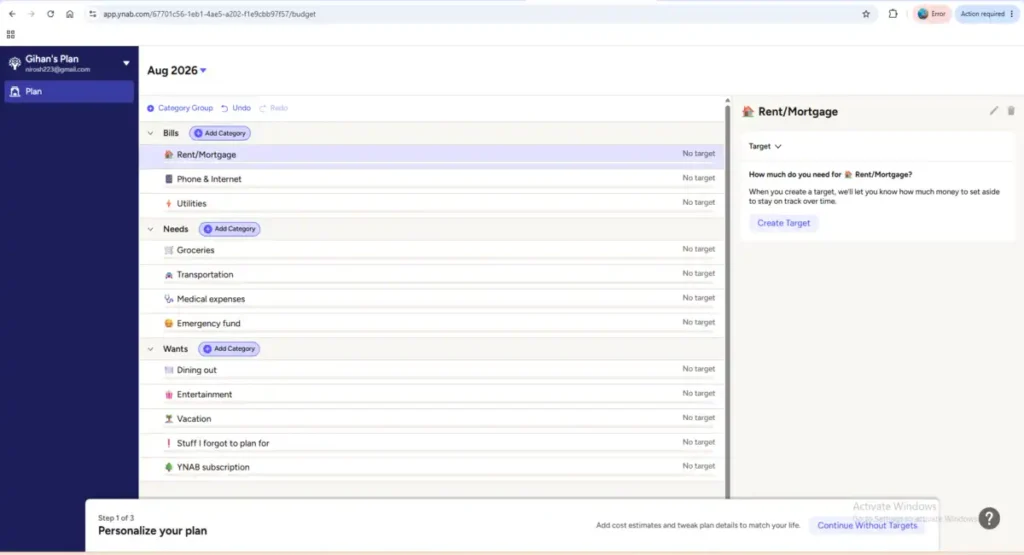
YNAB remains the gold standard for people who need structure, not just visibility. It is a structured, zero-based budgeting platform focused on proactive allocation, best suited for users who want strict budgeting discipline and hands-on control. Every dollar gets assigned a job the moment it arrives, which forces a decision-making moment instead of a passive scroll through a dashboard.
Why it works behaviorally: Zero-based budgeting exploits a well-documented psychological principle called the endowment effect. Once you have mentally “given” a dollar a job, spending it elsewhere feels like a loss rather than a neutral transaction. That small friction is often enough to interrupt an impulse purchase before it happens.
Best for: People who have tried “hands-off” apps and kept overspending anyway. If your problem is a lack of guardrails rather than a lack of visibility, YNAB is the one to pick.
Trade-off: The learning curve is real. Expect to spend the first two to three weeks actively building your budget categories rather than passively watching them populate.
Pricing: Roughly $15/month or $99/year, with regular student and nonprofit discounts.
2. Monarch Money — Best Personal Finance App for Couples and Households
Monarch has rapidly become the app of choice for households managing money together, and for good reason. Beyond budgeting features, Monarch includes a net worth tracker, investment dashboard, personalized reports, and bill reminders, and its collaboration tools stand out because users can tag expenses and set shared savings goal. Recent updates include an AI assistant, weekly spending recaps, improved goal-setting tools, and support for equity compensation.
Why it works behaviorally: Shared financial visibility reduces what researchers call “financial infidelity,” the small hidden purchases partners make when they assume the other person will not notice. When both partners see the same dashboard in real time, the accountability loop shifts from an occasional, tense conversation to a constant, low-friction ambient awareness. That shift alone prevents a huge share of the money arguments couples have.
Best for: Couples, families, or roommates who need one shared financial picture without merging every account.
Trade-off: Monarch leans more toward automation and reporting than the strict discipline of zero-based budgeting, so a household that needs hard guardrails may still want to pair it with stricter category rules.
Pricing: Around $14.99/month or $99.99/year, with a free trial.

3. Quicken Simplifi — Best Personal Finance App for Investment and Retirement Tracking
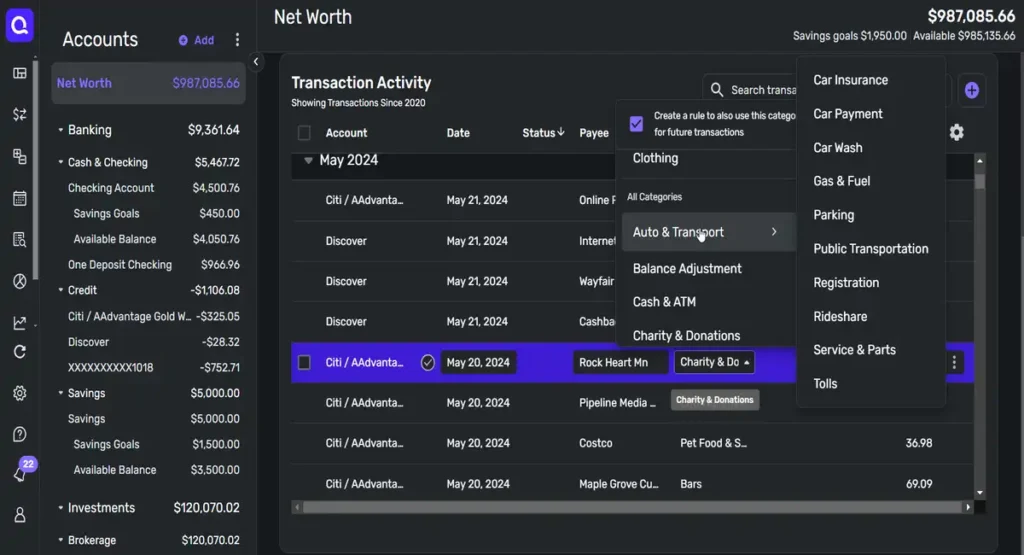
If your financial picture has grown beyond simple budgeting into investments, retirement accounts, and a real net worth to track, Simplifi is the strongest option on this list. Quicken Simplifi delivers investment tracking depth, including time-weighted and internal rate of return calculations plus a fifteen-variable retirement planner, at a price point most competing apps do not approach.The app has been recognized by CNBC Select as “Best App for Planners,” by Engadget as “Best Mint Alternative Overall,” and by PC Magazine with its Reader’s Choice Award for Top Personal Finance Software.
Why it works behaviorally: Simplifi’s “Spending Plan” reframes budgeting around what is left to spend after bills and savings are already accounted for, rather than a rigid category grid. For people who find category-based budgeting exhausting, this single-number framing reduces the cognitive load enough that they actually check the app daily instead of avoiding it. This connects directly to the monthly cash-flow habits I outlined in my monthly saving strategies article, where the goal is always to reduce decision fatigue, not add another spreadsheet to maintain.
Best for: Investors and anyone who wants a single, comprehensive view of net worth, cash flow, and retirement progress without buying separate tools.
Trade-off: Simplifi does not track crypto by wallet address or complex entity structures like trusts, so high-net-worth users with unusual holdings may need a supplementary tool.
Pricing: Around $3.99/month, making it the most affordable of the three.
Best Personal Finance Apps Comparison Table
| App | Best For | Starting Price | Standout Feature |
|---|---|---|---|
| YNAB | Behavior change and strict discipline | ~$15/month | Zero-based budgeting |
| Monarch Money | Couples and households | ~$14.99/month | Shared goals and AI assistant |
| Quicken Simplifi | Investment and retirement tracking | ~$3.99/month | 15-variable retirement planner |
No single app in this table wins every category, which is exactly the point. The best personal finance app for you depends on which financial behavior you are actually trying to change.
How to Choose the Best Personal Finance App for Your Brain, Not Just Your Bank Balance
Most comparison articles stop at features. That misses the actual decision point. Ask yourself these three questions before you commit to any of the tools above.
Do You Overspend Because You Cannot See the Number, or Because You Ignore It?
If you genuinely do not know your balance in the moment of a purchase, an automation-heavy tool like Monarch closes that visibility gap. If you know the number and spend anyway, you need the friction of YNAB’s category assignment system, because visibility alone will not stop an impulse-driven brain.
Are You Managing Money Alone or With Another Person?
Shared accountability changes the entire behavioral equation. A solo user optimizing for personal discipline should lean toward YNAB. A household needs the shared, real-time visibility that Monarch was built around.
Is Your Bottleneck Spending Discipline or Long-Term Visibility?
If your day-to-day spending is already under control but you have no clear picture of retirement readiness or investment performance, Quicken Simplifi solves a different problem than the other two apps, and it solves it well.
This same self-diagnosis approach is what I walk through in my breakdown of the 1-3-6 Savings Rule, where the framework only works once you have correctly identified which part of your financial behavior is actually the weak link.
Common Mistakes People Make When Choosing the Best Personal Finance Apps
Chasing features instead of adherence. The app with the most features is worthless if you stop opening it after three weeks. Every source in this comparison, from structured zero-based platforms to modern forecasting apps, agrees that the deciding factor is which tool a user actually keeps using.
Ignoring the free trial period. All three apps above offer a free trial or a low-cost entry point. Use it deliberately. Track one full pay cycle before committing, because a single week rarely reveals whether the feedback loop actually changes your behavior.
Underestimating bank sync reliability. Real-world relevance for account integration matters more than a long feature list, since a budgeting tool is only useful if it reliably pulls in your actual transactions. If an app constantly disconnects from your bank, the resulting manual entry defeats the entire behavioral advantage of automation.
Skipping the psychological fit. A disciplined, detail-oriented person may thrive with YNAB’s granular categories, while the same system will overwhelm someone whose brain needs simplicity. Match the tool to your own decision-making style, not to a review site’s overall ranking.
Do the Best Personal Finance Apps Actually Beat a Spreadsheet?
A stubborn myth persists that a well-built spreadsheet does everything these apps do for free. In a narrow sense, that is true. A spreadsheet can hold the same numbers. What it cannot do is close the feedback loop automatically, and that gap is the entire reason budgeting apps exist.
A spreadsheet requires you to remember to open it, manually enter every transaction, and reconcile errors by hand. Each of those steps is a fresh decision point where a tired or distracted brain can simply skip the task. The best personal finance apps remove that decision point by pulling transactions automatically, categorizing most of them correctly, and pushing a notification the moment something looks off. You are not relying on willpower to check your finances. The app is doing the checking and only interrupting you when it matters.
This is the same principle behind automated savings transfers outperforming manual ones. Removing a human decision point from a repeated behavior is almost always more effective than trying to strengthen willpower around that same decision. A spreadsheet asks you to be disciplined every single day. A good app asks you to be disciplined once, during setup, and then enforces the rest structurally.
Security and Privacy Considerations Before You Link Your Accounts
Before connecting a bank account to any budgeting tool, it is worth understanding how the connection actually works. Most reputable apps, including all three covered in this guide, use licensed data aggregators that create a read-only connection to your bank. That means the app can see transaction data but cannot move money or make changes to your account.
Look for two-factor authentication, clear data-deletion policies, and a public security page before signing up. Reading the privacy policy takes ten minutes and answers most of the questions people ask after the fact. If an app cannot clearly explain how your data is encrypted and stored, that is a reasonable signal to look elsewhere, regardless of how polished its dashboard looks.
Frequently Asked Questions About the Best Personal Finance Apps
What is the best personal finance app for beginners? Quicken Simplifi tends to suit beginners best because its Spending Plan approach requires less setup time than a full zero-based budget, while still giving a clear daily number to work from.
Are the best personal finance apps safe to link to my bank account? Reputable apps use bank-level encryption and read-only data connections through licensed aggregators. None of the three apps in this guide store your banking credentials directly, though it is always worth reviewing each provider’s current security documentation before linking accounts.
Do I need to pay for a personal finance app to see results? Free tiers exist, but the paid tools in this guide justify their cost through deeper forecasting, investment tracking, and reduced manual entry, which are exactly the features that keep people engaged past the first month.
Can one app replace a financial advisor? No. These tools organize and visualize your financial behavior, but they do not replace personalized advice from a licensed financial professional, particularly for tax planning, estate planning, or complex investment decisions.
Final Verdict: Which of the Best Personal Finance Apps Should You Choose?
If discipline is your gap, choose YNAB. If shared household accountability is your gap, choose Monarch Money. If long-term visibility into investments and retirement is your gap, choose Quicken Simplifi. All three are genuinely among the best personal finance apps available in 2026, and the right pick has less to do with which app reviewers rank highest and everything to do with which feedback loop your own brain actually responds to.
For more on why some money habits stick while others quietly fail, read my related piece on the SpaceX mindset and how it applies to long-term financial resilience.
External Sources Referenced:
- Origin — 7 Best Personal Finance Management Tools for 2026: https://useorigin.com/resources/blog/7-best-personal-finance-management-tools-for-2026-expert-review
- Quicken — Affordable Personal Finance Apps With Investment Tracking Features (2026): https://www.quicken.com/blog/affordable-personal-finance-apps-with-investment-tracking-features-2026/
- NerdWallet — The Best Budget Apps for 2026: https://www.nerdwallet.com/finance/learn/best-budget-apps
- Forbes Advisor — Best Budgeting Apps of 2026: https://www.forbes.com/financial-services/best-budgeting-apps-2/
Disclaimer: This article is for informational and educational purposes only and does not constitute financial advice. Pricing and features were accurate at the time of writing and may change. Consult a licensed financial advisor before making significant financial decisions.
Written by Dr. Nirosh, physician and founder of thedopaminedoc.com, exploring the intersection of neuroscience, behavior, and money.